Match Kit
As Glasgow City opens a public pitch for its next kit partner, we look at the designers and grassroots communities finally treating women’s football like the cultural powerhouse it is.
By Glorious
If I had a pound for every time I heard someone say women’s football is booming, I probably would not be writing this story. The phrase has become its own genre of LinkedIn post at this point, usually attached to a panel talk, a graph pointing upwards or somebody discovering the existence of a football shirt designed for women as though it is a revolutionary concept. But beneath all the noise and investment decks and growth forecasts, something genuinely interesting has been happening around the game. Not just in stadiums, but outside them too.

For the past few years, women’s football shirts have started behaving less like sports merchandise and more like cultural objects. A women’s football shirt now moves through the world the same way band merch or good streetwear does. It turns up at festivals, fashion week parties and Sunday coffee shops. Girls wear Arsenal shirts with adidas track pants and tiny sunglasses like they’ve owned them for years. There are football shirts on Depop selling like archive fashion pieces. There are women who have never played football building entire visual identities around the game anyway.
And the numbers are starting to catch up with the feeling. Deloitte estimated global women’s sport revenues would pass $1.8 billion in 2025, while sports merchandise and apparel continues to be one of the fastest-growing areas attached to women’s football fandom. Search demand for women’s football shirts spiked 525% around the last Euros final alone. But the more interesting shift is cultural. The line between supporter and wearer has become blurry in a way the men’s game still doesn’t fully know how to process.
Which is maybe why some of the most interesting people in women’s football right now are not coaches or owners or sporting directors. They are designers. Illustrators. Creative directors. Stylists. People looking at football and thinking: this could be far more fun.
Historically, football kit has been weirdly rigid for something meant to represent identity. Especially in the women’s game. Women buying men’s cuts and rolling the sleeves. Goalkeeper kits that looked like they had been designed during a power cut.
Half the Lionesses squad spending Euro 2022 quietly anxious about their periods leaking through Nike white, because nobody at the manufacturer had thought about it, until Beth Mead and Georgia Stanway raised it publicly and then raised it again before the shorts finally got swapped for blue in 2023. Shirts that technically existed but never really felt like they belonged to the people wearing them. The women’s game inherited a lot of systems built for somebody else and was told to make it work.
Now the culture around women’s football is moving faster than the structures holding it. The interesting bit is that this is no longer just happening around football. It is happening on the pitch too.
shifting

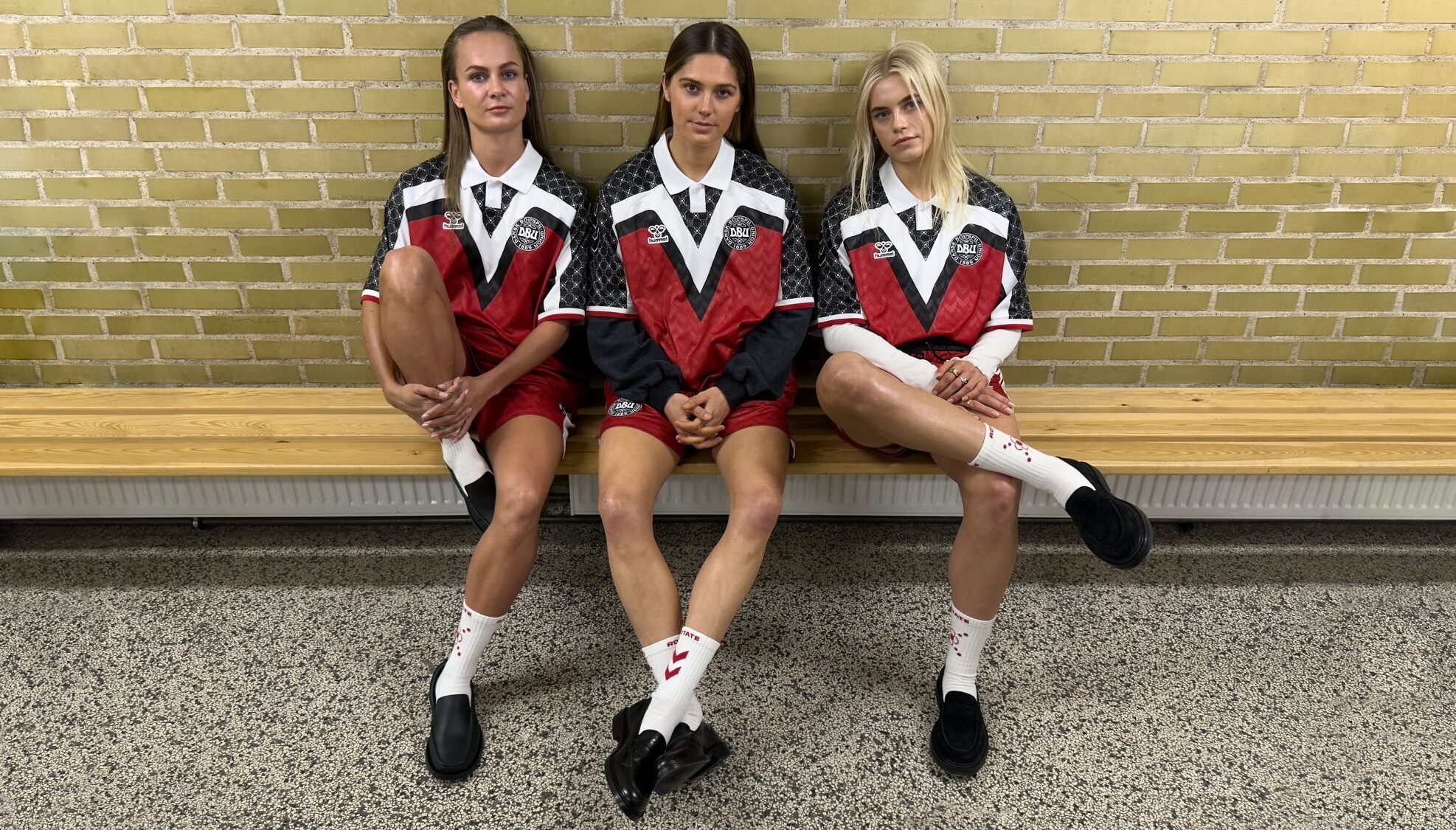
You can see it in Denmark, where Hummel have become one of the smartest brands in football by understanding that women’s football audiences do not want to be marketed to like 14-year-old boys in 2006. Last year, Rotate Birger Christensen designed a special-edition Denmark women’s national team shirt with Hummel and DBU, complete with vintage collar, chevron graphics and a full lifestyle drop that looked more Copenhagen Fashion Week than UEFA media day. Months earlier, Hummel teamed with Halo for another Denmark release in deep bordeaux with skydiving-inspired graphics. Neither felt like novelty gimmicks. They felt like brands recognising that women’s football fans also exist inside fashion, nightlife, design and internet culture. Which sounds obvious, but football is surprisingly slow at obvious things.
Grace Wales Bonner and adidas approached Jamaica’s national team shirts through diaspora, tailoring and craft rather than pure performance wear. Martine Rose turned the forgotten story of the 1971 unofficial England women’s team into one of the most talked-about football shirts of the last decade. Off-White‘s work with AC Milan blurred football, luxury fashion and cultural signalling so aggressively that half the internet seemed unsure whether it was a kit launch or a runway collection.


And underneath the elite level, things get even more interesting.
The real experimental energy in women’s football often sits at grassroots, where nobody is waiting for permission. Whippets FC worked with designer Sophie Hird and Umbro on kits that looked pulled from a lost 1994 music video. Peaches FC built a “Peaches & Cream” shirt with Admiral that felt knowingly camp and proudly local. Goal Diggers have spent years treating shirts less like merchandise and more like political and cultural objects. Camden Town WFC worked with Hattie Crowther on a redesign built around women’s bodies rather than shrinking men’s patterns and hoping for the best. The Hackney Laces network partnered with Nomad Studio on kits pulling from skate graphics and surf culture rather than traditional football aesthetics.
That is the thing football still occasionally misses about women’s football. It is not arriving neatly. It is arriving through communities. Through creative scenes. Through queer culture. Through women who already had strong visual identities and social lives and aesthetics before they cared about football. The sport did not create that audience. The audience arrived fully formed and started reshaping the sport around itself.
traditions

Which brings us to Glasgow City Football Club.
Not because this is really a story about one club. It isn’t. It is a story about where the game is going. Glasgow City just happen to be one of the first professional clubs willing to say it out loud.
Recently, the club publicly opened applications for its next kit partnership, inviting brands, designers and creative partners to pitch for the 2027/28 season. Not quietly behind closed doors. Publicly. Like a creative brief. Like an open casting call. Like they understand the shirt is not just an operational decision anymore.

And the language inside the manifesto matters because it does not read like a procurement document written by somebody terrified of LinkedIn. It talks about women-first shaping and design “not an adaptation, the starting point.” It talks about culture, visibility and identity. It openly says the club is not looking for a “standard supplier relationship” but “a true growth partner”.
More importantly, it sounds like people who actually understand modern women’s football audiences.
Glasgow City are not a random challenger club trying to go viral for attention. They are the most successful women’s club in Scottish football history, founded in 1998 by Laura Montgomery and Carol-Anne Stewart, who started it because their matches kept getting bumped at the last minute so the pitches could stay tidy for the men, with fourteen consecutive league titles between 2007/08 and 2020/21 and regular UEFA Women’s Champions League appearances. The club currently competes in the Scottish Women’s Premier League and remains independent, women-founded and women-led.
That independence is probably why this feels different.
Most women’s teams still exist inside structures built around the men’s game. Glasgow City don’t. Which is probably why they sound freer to rethink things.
The manifesto openly acknowledges that many structures around women’s football were inherited rather than intentionally designed for it. That is unusually honest language for professional football. Especially around merchandise and kit supply, where clubs often pretend every existing model works perfectly while supporters spend £80 on shirts cut like damp bin bags.

There is also something bigger sitting underneath all this. Women’s football clubs increasingly behave less like traditional football institutions and more like modern cultural brands. Angel City FC have creative directors, fashion partnerships, celebrity investors and pulled in $6 million in merch in their first season alone, leading the league. Gotham FC partnered with womenswear label Aligne. And ahead of its 2026 season, the NWSL teamed up with DMV-based designer and Washington Spirit creative director Domo Wells on a league-wide knitwear collaboration through her label Dead Dirt, creating bespoke knit jerseys for every club in the league, including the expansion sides. Arsenal’s collaboration with Aries did not even really feel like football merch. It felt like London streetwear with football stitched through it.
Football has spent decades pretending sport exists separately from the rest of culture when clearly it never did.
Women’s football just seems less embarrassed about admitting it.


Which is why Glasgow City continuing to work with Foudys feels important too. Foudys has spent years treating women’s football merchandise as something worthy of care, attention and proper retail strategy long before bigger retailers realised there was money in it. Glasgow City are effectively saying: if you want to work with us, you work with the ecosystem already supporting the women’s game too. That kind of thinking matters because this is not just aesthetics. There is a real business case sitting underneath all of it.
Supporters buy things they emotionally connect to. They buy stories. Identity. Belonging. The reason so many grassroots women’s teams have developed cult followings is because the shirts actually feel connected to the communities around them. They are not just seasonal inventory.
And honestly, football could probably do with being less serious about itself sometimes.
One of the best things about women’s football culture right now is that it still allows space for experimentation. For oddness. For humour. For references outside football. It has not fully calcified into heritage marketing and endless nostalgia loops yet. A women’s football shirt can still surprise you.
That is exactly what Glasgow City seem to understand.
The interesting part is not whether they end up with adidas or Hummel or Umbro or some independent label nobody sees coming. The interesting part is that a professional football club looked at the future of women’s football and thought maybe kit should feel more like culture and less like procurement.
Honestly, they might be right.
And if you fancy it, applications are open until 5th June 2026. Find out more information here.
More info about Glasgow City FC here.
Title image: Rotate Birger Christensen designed a special-edition Denmark women’s national team shirt with Hummel and DBU, via Birger Christensen Collective
Share This Article
If you love this you’ll also love...
Bend It Like Barriers
Lounging on the sofa on Sunday I found myself watching Bend It Like Beckham again. It made me wonder: have things really changed for South Asian women in football? A deep dive into whether Jess Bhamra's fight is still a reality today.
Now Days
What’s it like to be friends on land and bitter rivals the second you hit the water? We head to Kelly Slater’s Surf Ranch to meet five of the world’s best surfers, a generation that has grown up together, now competing for the same titles as each other’s greatest support system and most dangerous obstacles.

Beyond the Bling
Don’t let the high hair and tans fool you- the world of Irish dance is shaped by discipline and legacy, where years of training build towards a performance that lasts only minutes. We go backstage at the CLRG World Irish Dance Championships in Dublin.
The Playmaker
Emily Bisgaard’s art breaks the rules, mixing paint and play to challenge how we think about identity and belonging. From bold murals to engaging community projects, she turns life’s messy edges into spaces where courage and connection take centre stage.