Good Crowd
Fifteen wildly different women, sanctioned violence, mud, bruises, cowboy hats, and an obsessive social life. Rugby shouldn't be the easiest sport to sell to women, yet it has become the most intoxicating proposition in modern sport.
By Glorious
Photography by Jas Ghata-Aura
There is no shortage of evidence that women’s rugby is having a very good time.
There are numbers, lots and lots of numbers. Participation, audiences, attendances, investment, broadcasting, fandom, social media, grassroots growth. There were 81,885 people at Twickenham to watch England win the World Cup in 2025, the largest crowd ever recorded for a women’s rugby match. Almost exactly a year later, another 59,871 turned up to watch the Red Roses play New Zealand.

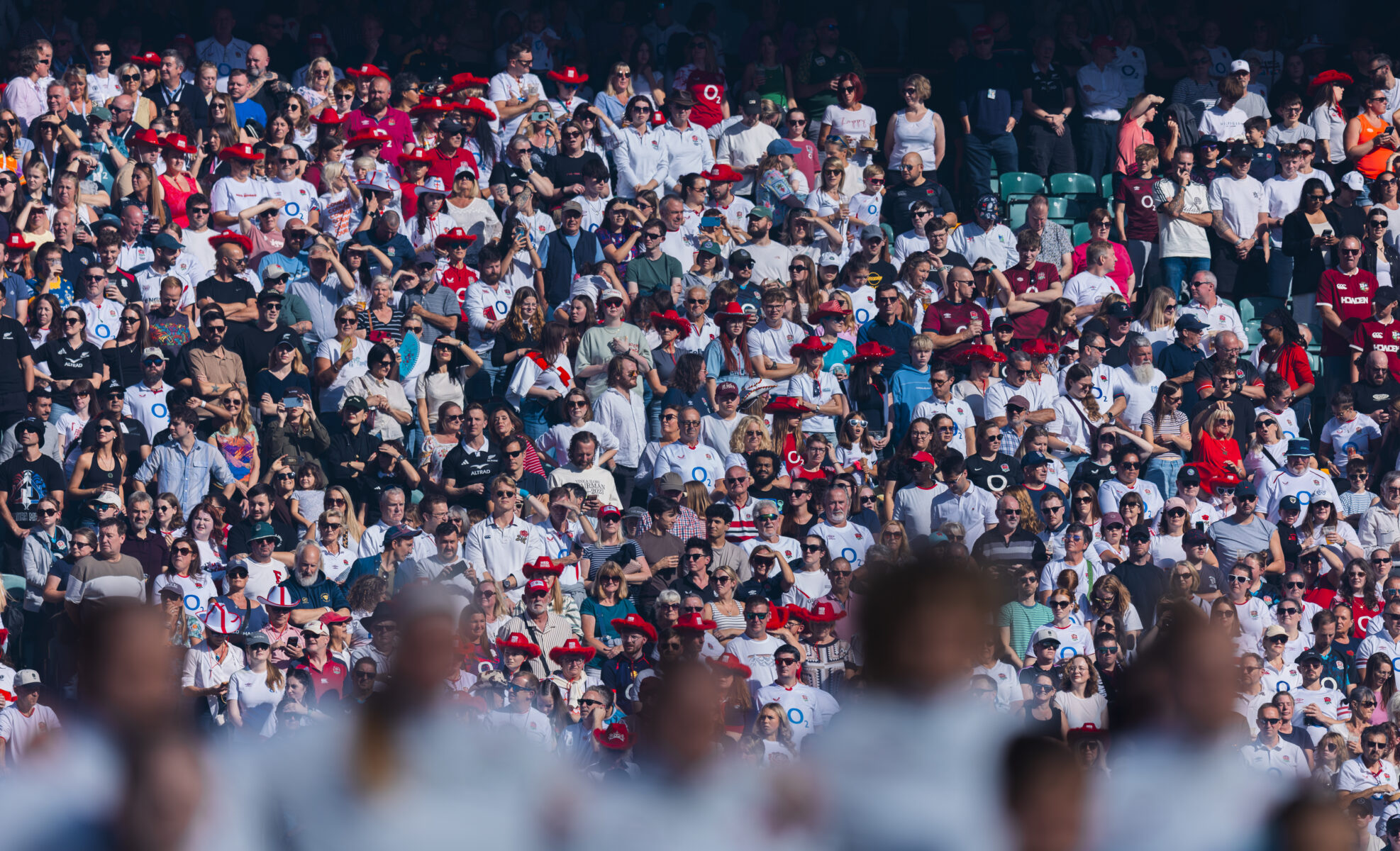
Some of those 59,871 are in these photographs. Jas Ghata-Aura was at Twickenham for Glorious as England beat New Zealand 26-19 in the WXV Global Series, photographing the action on the pitch, but also the people around it. The crowds, the fans, the players walking out to meet them. Women’s rugby has been building towards scenes like these for years, often rather relentlessly, with players doing a fair amount of the publicity themselves along the way. Looking through Jas’s pictures alongside an increasingly ridiculous number of reports I had open on my laptop, the question wasn’t whether women’s rugby is working. It quite obviously is.
I wanted to know why it works so well.

dedicated

Because there is more going on here than a brilliant England team winning lots of rugby matches. The game has built a huge international audience while increasing the number of girls who actually play it. It has created sporting idols without making them feel entirely unreachable. It has attracted new fans without requiring them to arrive with a lifetime’s knowledge of rugby. And it has made room for lots of different kinds of women.
Perhaps I should have written about this before, having spent the past few years quite happily aboard the Red Roses train and, yes, occasionally in a cowboy hat.

The Red Roses are a useful place to start. Abbie Ward returned to international rugby after having her daughter. Others have arrived via university rugby, club rugby, sevens, or late conversion from different sports. Some combined elite rugby with degrees, jobs and careers because being an international player did not yet mean being a full-time professional. England only introduced full-time contracts for its women in 2019, so the current generation sits across two eras. Nobody should romanticise the first one. Women having to hold down jobs while representing their country was not charming, it was underinvestment.
But it has left women’s rugby with an unusual generation of elite athletes whose lives were not entirely shaped by elite sport from childhood.

Amy Cokayne combines international rugby with work as an RAF police officer. Emma Sing studies Bioveterinary Science and still helps out on the family farm alongside her international career. They are exceptional women, obviously, but then they are representing England. Being exceptional rather comes with the territory. What is more interesting is how different they are from one another, the routes they took to get there and how much of those differences the culture around women’s rugby seems quite happy to leave intact.

Compare that, very loosely, with the increasingly streamlined life of an elite level male footballer. Take a team and there is a decent chance that many have been inside some version of a professional system since they were children, training in similar environments, developing similar bodies, driving the same cars, playing many of the same video games and spending a frankly astonishing amount of time in swimming pools. (No, seriously, ask a professional footballer how much time he spends training in a pool each week- It will blow your mind.) I know, I know, not every footballer, but I have interviewed enough of them over the years to know both that the stereotype is unfair and that there is a reason it exists. The point is not that footballers are boring. It is that the system rewards conformity. Women’s rugby has simply not had enough time to develop the same degree of professional uniformity.

It will, to some extent. Better pathways mean talented girls will be identified younger and future Red Roses will spend more of their lives being professional rugby players. That is progress. But right now the sport has an interesting combination of elite performance and recognisable lives, and that has become part of its fandom.
The players have worked extraordinarily hard at that relationship too. According to Women’s Sport Trust, the 2025 Red Roses World Cup squad collectively posted 1,730 times on Instagram during 2025, compared with 673 posts from the England men’s squad studied. On TikTok it was 848 videos to 162, with the Red Roses generating 24 million views.

Working at Glorious, we have pitched some fairly out-there creative campaigns across sport over the years and often found that supposedly more traditional corners are remarkably willing to have a go. Rugby has tended to be more cautious. Don’t get me wrong, there has been plenty of good work around it. The investment in broadcasting, access and getting more girls into the game has been hugely important. But the marketing itself can still feel quite traditional, and often designed for an audience already standing fairly close to rugby. Crocheted Red Roses are lovely, yes, but there is a much bigger cultural world available to the sport than that. Which makes it all the more interesting that so much of the fandom seems to have grown almost from the bottom up. The players built audiences of their own, young women found them on their phones and fans created their own rituals and references. In some ways, the culture has moved faster than the marketing.
And perhaps that helps explain why the fandom can feel unusually personal. There is something slightly Spice Girls about the whole thing, in the best possible sense. Pick yours. They are all exceptionally good at rugby. That bit is a given. What differs is everything around it. Ellie Kildunne has the speed, the lasso and the cowboy hats. Hannah Botterman is very publicly Hannah Botterman. Abbie Ward returned after having her daughter. Sarah Bern speaks candidly about body image. Different players have very different, very public personalities, backgrounds and lives, and rather than sanding those differences away, the culture around the team seems to embrace them. They aren’t characters invented to service a fanbase. They are recognisably different people who happen to be brilliant at the same thing.

For a girl already playing, that fandom has another layer. The person walking out at Twickenham is doing a vastly more accomplished version of something she did with her friends at school or at her community rugby club. She can watch Kildunne play for England, follow her online and then go back to training and attempt whatever she has just watched, probably with mixed results.
That feels particularly useful when sport has such difficulty keeping teenage girls. Women in Sport estimates that 1.3 million girls who once considered themselves sporty disengage during their teenage years, with worries about judgement, not being good enough and not having the right body among the barriers.

accomplished
Rugby has a rather good answer to at least some of that because there is no single useful rugby body. It requires women to be big and small, fast and heavy, tall and compact, powerful and agile. Fifteen bodies built exactly the same way would be fairly useless on a rugby pitch. There is a position for the woman who can run like hell and another for the woman who can move someone who would prefer not to be moved. At a moment when girls are still being encouraged to worry about the amount of space their bodies occupy, rugby quite literally requires some women to occupy more of it.

That does not make rugby immune to body anxiety. Kildunne has spoken openly about body dysmorphia and disordered eating, while Bern has spoken about growing up bigger and not feeling pretty enough. What rugby can put in front of a girl is a group of exceptional athletes whose bodies are visibly different because they are required to do different things. There is no single silhouette to aspire to.
There is similar latitude in how women are allowed to present themselves. Among the players, there is room for scruffy and glamorous, loud and quiet, serious and funny, without one version of femininity feeling more at home in the sport than another. And that breadth goes beyond personality or appearance. Gay and straight women are visibly part of the game, as are women with very different relationships, backgrounds, families and lives.

The sense of breadth extends to the people around the game too. Young girls in cowboy hats, teenagers and families fill Jas’s photographs. The game is getting bigger, but so is the idea of who belongs in it.
For the women playing, rugby also offers somewhere to be aggressive, physical and competitive without those qualities having to define them away from the pitch. At community level, you can train, play, get filthy, spend a disproportionate amount of time with the same group of women and have a glass of wine afterwards. Rugby’s social life has always been part of rugby, and friendship is a pretty compelling reason for a teenage girl to keep turning up.

And girls are turning up. Sport England’s Impact ’25 report found that girls’ club participation in England rose 49 per cent, from around 18,000 to 26,800, while around 40,000 girls aged six to 12 were introduced to rugby. The route in doesn’t have to begin in childhood either. Women join community teams as adults, including mothers who have spent years getting up early on Sundays, driving a child to rugby and standing beside a pitch before deciding they quite fancy some of the action themselves.

friendship

Watching is a slightly different proposition. Some of those 59,871 people in Jas’s photographs will already watch club rugby. Some will start. Others probably won’t, and it would be silly to treat that as some great failure. Marquee sport has never worked like that. Wimbledon does not turn everybody on Centre Court into a regular at their nearest tennis tournament.

PWR’s average attendances grew 23.4 per cent in 2025/26 and its social following rose 132 per cent, but following the game now extends well beyond turning up every weekend or watching 80 minutes on television. Every PWR match was broadcast live last season, including free coverage through BBC Sport and YouTube, while highlights, TikTok clips, player interviews, podcasts, fashion and GRWMs create dozens of smaller ways in. A girl can meet rugby at school, find a Red Rose on her phone, watch her at Twickenham and discover her club without ever consciously deciding to “become a rugby fan”.

English rugby does still carry some of its old associations with private schools, whiteness and class, and popularity at Twickenham does not automatically make the game accessible to everybody. Where rugby is played, whether a school offers it, whether there is a community team nearby and whether a girl feels that she belongs there still matter.
But the audience is already changing. World Rugby found in 2026 that 49 per cent of women’s rugby fans had become fans within the previous two years. At the 2025 World Cup, 44 per cent were attending a women’s rugby match for the first time and 15 per cent were at their first rugby match of any kind. The people in Jas’s photographs are not simply the old rugby audience turning up to watch women. A substantial number are new.
The route in doesn’t have to look one specific way, and neither do the women taking it. Perhaps that goes some way to explaining why the numbers keep growing. Or at least, I think so. Tell us what you think @glorioussport.
Photography by Jas Ghata-Aura, find more of their work here.
Share This Article
If you love this you’ll also love...
EVOLVE Boxing
Behind a roller shutter on an Amersham industrial estate sits a boxing gym full of young fighters, world-ranked coaches, Pilates mums and two wandering French bulldogs. Evolve Boxing Academy is proof that the best stories in sport rarely live where you expect them.
Glitter & Globes
In Lake Placid, in front of 35,622 fans, Jessie Diggins skied the last race of her career at the first Cross-Country Skiing World Cup Finals ever staged on American snow. We head to one of the most thrilling three-day moments women’s endurance sport has produced in years.
PART 2: Cheer
In 2022, Glorious examined how Hollywood turned one of the world's most demanding sports into one of its most enduring stereotypes. Four years later, cheerleading is still loud, still proud, and still smiling, but now mainly on its own terms. Documentaries, social media, and a new generation of filmmakers are finally closing the gap between Hollywood and reality.
RADICAL WHO?
The Speed Project is a coveted, near-mythical 340-mile desert race built on the promise of total freedom: no route and no rules. Runner, filmmaker and activist Tilly GW has spent five years helping to make that promise a reality.