
Glitter & Globes
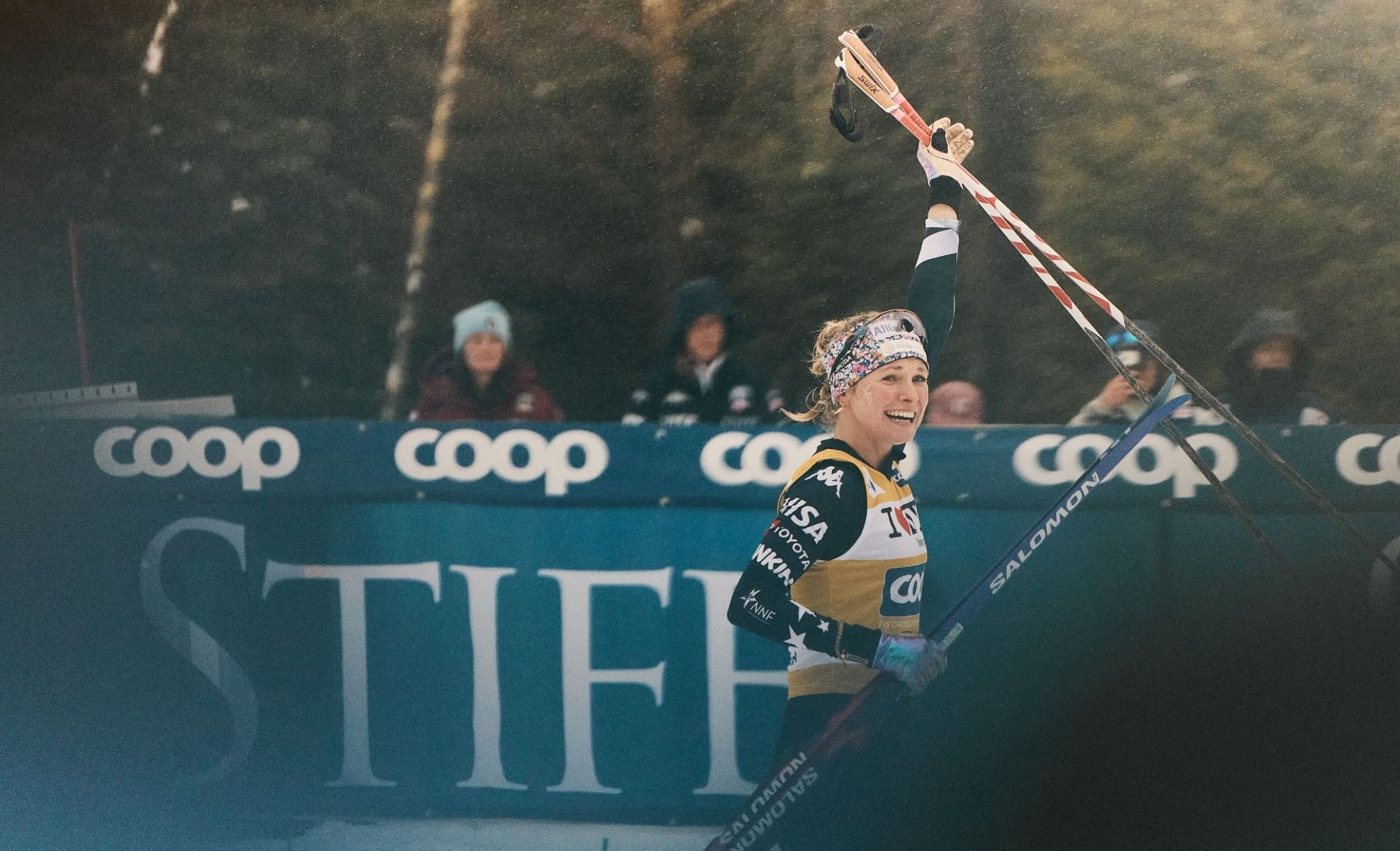
In Lake Placid, in front of 35,622 fans, Jessie Diggins skied the last race of her career at the first Cross-Country Skiing World Cup Finals ever staged on American snow. We head to one of the most thrilling three-day moments women’s endurance sport has produced in years.
By Glorious
Photography by Dominique Powers
There is a real possibility that, even if you watch sport closely, and unless you’re from a Nordic nation, women’s cross country skiing has either passed you by entirely or sits in your peripheral vision as something you know exists without ever quite knowing what you are looking at. It belongs to that strange tier of global sport that is enormous, culturally embedded and fiercely competitive, and yet entirely missable from the wrong country.

For a lot of people, it only really lands in flashes. A race buried in the Winter Olympics schedule, a clip doing the rounds that looks far harder than it should, a name you recognise without quite placing why. Our first proper exposure came during the Milano Cortina 2026 Winter Olympics, where Sweden’s women won five of the six available cross country golds and the sport took whole afternoons in parts of Europe that already understand it.

In Sweden, the women’s skiathlon drew 1.72 million viewers, the country’s most-watched sporting broadcast since the previous Summer Games, while in Norway audiences pushed close to 90 percent share for the biggest races. It is not niche. It has just not been handed to everyone equally. In the UK, by contrast, YouGov polling found that only around one in five viewers who watched the Games said they were interested in cross country at all. The audience is already there. Britain and the US have, predictably, gravitated toward the kind of winter sports with a hill attached.

Then in March, photographer Dominique Powers, whose work has shaped some of our most important US Glorious stories, messaged from the road. She was on her way to Lake Placid for the World Cup Finals. “This event, for all cross country skiers, is akin to playing basketball all your life, then going to a WNBA game,” she said. “It’s going to be insane!”
She was right. For Dominique, this was not just another assignment. She grew up in a ski family in Vermont, where cross country skiing sat at the centre of daily life.
Her father was on the US Biathlon team himself back in the day, then worked as a wax tech for the US Nordic Combined team, while her mother still teaches cross country ski lessons in Ripton, Vermont at 71 years old. “My favourite response growing up when people asked when I started skiing was that I skied before I could walk!” she told Glorious afterwards. Her older sister ski raced too, and this winter photographed the US Ski Team at the Olympics, making Lake Placid feel full circle for both of them as photographers and skiers.

Like a lot of kids growing up in New England skiing culture, Dominique came through the Bill Koch League, the youth development programme founded by Bill Koch, the first American man ever to win an Olympic medal in cross country skiing. Every finisher in her earliest age category was handed a lollipop at the end of their race. The programme still runs across New England and centres itself around making skiing fun before anything else. Dominique raced through that system, then through high school competition, eventually qualifying for the Eastern High School Championships. “Events and races every weekend, a community surrounding the snow and this beautiful yet painful sport,” is how she describes it now.

endurance

If you sit on the unfamiliar side of all this, a quick briefing. The Coop FIS Cross-Country World Cup Finals, staged over three days in March at Mt Van Hoevenberg in Lake Placid, New York, marked the close of the 2025/26 season and, for us, the centre of this story. Cross country sits in the Nordic discipline, built on endurance rather than gravity. No chairlifts, no slalom gates, no clean fall-line down a mountain. Athletes propel themselves across snow-covered courses using a combination of upper and lower body effort that has no real equivalent outside a small handful of sports. It has been on the Winter Olympic programme since the first Games at Chamonix in 1924, with women contesting it from Oslo 1952 onward, and now runs from sprint formats up to distances of fifty kilometres. It was the first time Lake Placid had hosted the circuit since 1979, and only the second time in over two decades that the World Cup had landed on American snow, after Minneapolis in 2024.

35,622 people turned up across those three days, packing out sections of the course where they stood a chance of seeing their favourite skier whip past in a matter of seconds before disappearing back into the trees. They stood through heavy snow, sleet and a final-day rain that soaked the course, cheering and waving flags, wrapped in padded jackets that had clearly been doing this for years. One woman had even planned her whole bachelorette weekend around watching the racing.

Dominique recognised a lot of the crowd instantly because she had once been one of them. Coaches she grew up skiing with. Parents from junior races. Former teammates. Families standing in the snow together for six straight hours just to watch athletes pass by for a few seconds at a time. “Watching the World Cup Finals alongside the people that I grew up racing with and against, coaches and parents from years past, all of us there witnessing the peak of the sport, was something I will never forget,” she said.
Among the people helping make the weekend run was Bernie, one of the only female wax techs on the circuit, who summed up the atmosphere around the event perfectly. “It’s more than just a race,” she said. “What you’re seeing here is a community coming together. People from all over the country, all over the world, enjoying the outdoors, enjoying a great sport. It’s great for the local economy, but it’s even better for the spirit of the community.”

And for many of them, standing for hours in freezing temperatures was about catching a glimpse of one skier in particular. Jessie Diggins was racing the final weekend of her career, retiring at the close of the season as the most decorated American cross country skier in history. Her Olympic gold in the team sprint at the Pyeongchang 2018 Winter Olympics alongside Kikkan Randall, the first US Olympic gold medal in the sport, still shapes the picture of what is possible for the country in Nordic disciplines. In the years that followed she became the public face of the campaign to bring the World Cup back onto American snow, an effort that came good in Minneapolis in 2024 and again, finally, in Lake Placid this year.

For Diggins, the weekend reached past the result sheet. “When I was a kid, I had to watch VHS tapes in the basement with my dad of races that had happened five years earlier,” she told Dominique between races. “That was the closest I ever got to this. 17-year-old Jessie would have just done anything to be here. We have to give this to the next generation. We have to let all these kids see firsthand because it’s different. Being close enough to hear us breathing is so different.”


For Dominique, photographing it carried a different kind of weight because she understood exactly what those crowds had waited for. “Having been exposed to the peak of endurance sport through five years of covering European cycling road racing like Paris-Roubaix and the Tour de France Femmes avec Zwift, didn’t make me jaded to the spectacle of an elite World Cup competition,” she said. “It allowed me to appreciate how special it is to have that level of ski racing accessible to fans to experience in person.”
stamina
The rest of the US team carried their own weight through it. Ben Ogden, who this winter became the first American man in fifty years to win an Olympic cross country medal, also grew up in Vermont, not far from Bill Koch himself. Ogden had been excited to close out the year here from the moment the Finals were first announced. “It’s so cool to see the power of the New England and US ski community,” he laughed. “Sometimes I feel like it’s one of those moments that makes me wonder if things happen for a reason or if they’re totally random, because this just feels too good to be totally random!”

Whilst Diggins sits at the centre of many spectators’ conversations, she is arguably surrounded by the strongest women’s era cross country has carried in years. Svahn has rebuilt her career after injuries that would have ended many others and arrived in Lake Placid as the reigning Olympic classic sprint champion. Sundling has dominated sprint racing across the last two Olympic Games, and won team sprint gold in Italy alongside Maja Dahlqvist. Karlsson is one of the strongest distance skiers on the circuit and took double gold at Milano Cortina, in the skiathlon and the 10-kilometre interval start. Ebba Andersson won the first ever women’s Olympic 50-kilometre. Weng, at 34, has been racing at this level for over a decade.
Competing at this level at the age of thirty four, the same age as Diggins, reads differently once you factor in what the sport actually asks of them, which does not fully come through on a screen. Cross country skiing is consistently rated among the most demanding endurance sports in the world for sheer aerobic capacity. Athletes fire arms, legs, core and back simultaneously, drawing from the same oxygen supply and sustaining that effort for up to an hour. Diggins has described her own job, in her own words, as “all it is is pain!”, and has talked openly about the moment she chose to treat that pain as a decision rather than as something being done to her. That sentence changes how you watch the rest of the race. It stops looking distant and starts to feel immediate.

Dominique still skis when she goes home to Vermont, though she admits she drifted away from the competitive side of the sport as an adult, trading VO2 max conversations for cycling, rock climbing and photography. Watching the World Cup return to American snow brought some of that feeling back. “What’s incredible about cross country skiing is the combination of power and grace,” she said. “There is such technique involved to glide gracefully and efficiently across the snow, both up and down hills, on the skinniest of skis. It’s beautiful and gripping to watch.”

The 2026/27 World Cup season opens in November. Diggins won’t be taking part, but the field she leaves behind, Svahn, Sundling, Karlsson, Andersson, Weng, is still there, still racing, and still skiing arguably the most physically unreasonable sport on the calendar. She also leaves it with a wider audience and a stronger foothold in the United States than the one she walked into. On the side of the track that weekend, Diggins’s nine-year-old nephew watched the women race past and turned to her. “These girls are so fast, they’re so strong,” he said. “I’m going to do that.” Cross country has always grown by being experienced rather than broadcast, which might be why the people who get it really get it. “Watching sports in person is what solidifies someone from a viewer to a true fan,” Dominique said. “Standing in the sleet cheering yourself hoarse as racers whiz by with a huge smile on your face, that’s something that makes life electric.” Maybe you’re one of them. When it comes back around, put it on. Give it ten minutes. Pick someone and follow them for a lap. You will work the rest out quickly enough.
Huge thanks to Dominique Powers, follow her here, and see more of her work here.

Title image: Jessie walking to the startline of the final race of her career, waving to roaring fans by Dominique Powers
Share This Article
If you love this you’ll also love...
Golden Girl
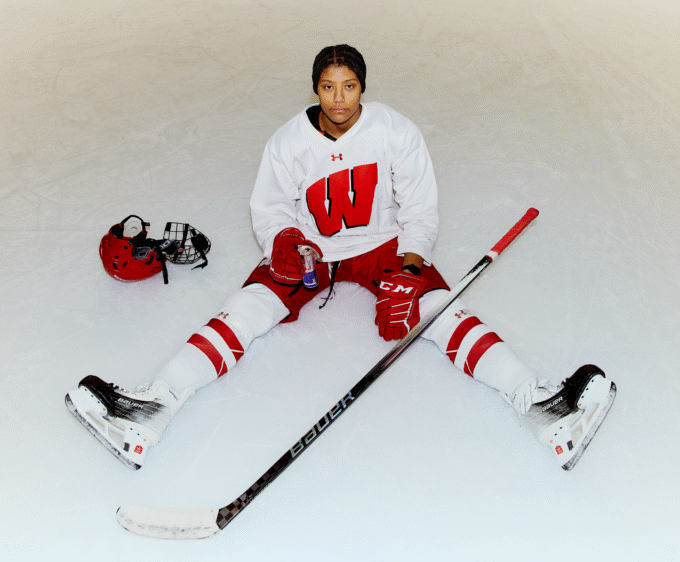
We met Laila Edwards before the gold medal. Before Milan. Before the headlines. In Wisconsin, with her family around her and Dominique’s camera rolling, we saw the making of a champion who would go on to help deliver Olympic history.

Sparking Culture
Dominique Powers’ courtside view to billion-dollar valuations, this is the story of how the LA Sparks and the league they play for braided community, commerce, and culture into a night out that feels like the future.

Now Days
What’s it like to be friends on land and bitter rivals the second you hit the water? We head to Kelly Slater’s Surf Ranch to meet five of the world’s best surfers, a generation that has grown up together, now competing for the same titles as each other’s greatest support system and most dangerous obstacles.
Iris Slappendel
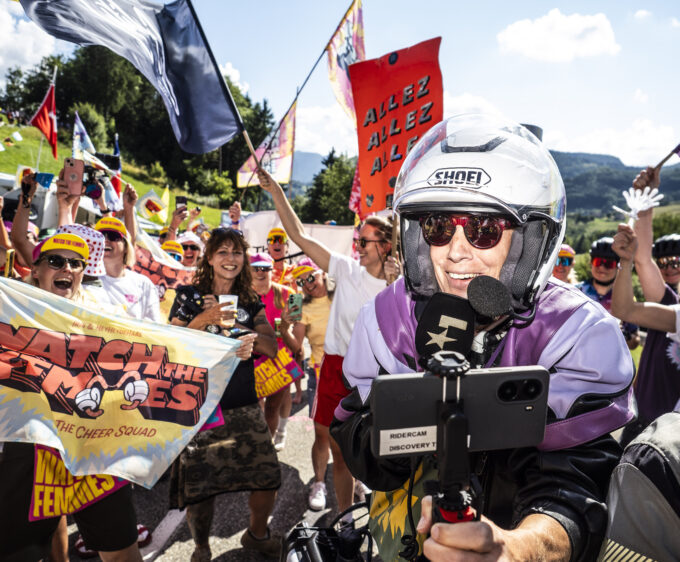
Halfway up a mountain at the Tour de France Femmes, it’s not the helicopters circling overhead waiting for the peloton that makes you stop, but a group of women, loud, coordinated, colourful, all chanting one name.