Iris Slappendel: Designing a More Joyful Future for Women’s Cycling
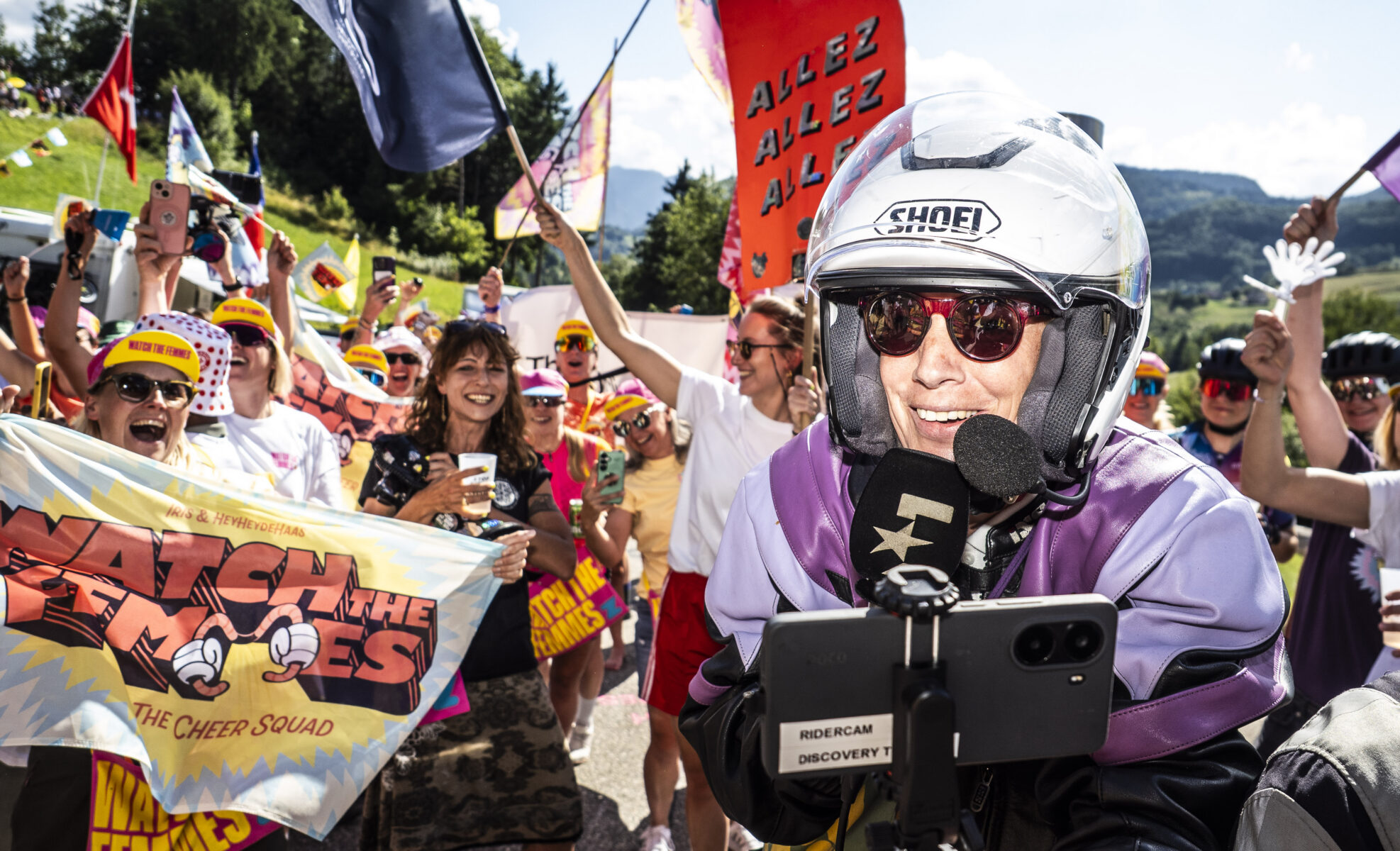
Halfway up a mountain at the Tour de France Femmes, it’s not the helicopters circling overhead waiting for the peloton that makes you stop, but a group of women, loud, coordinated, colourful, all chanting one name.
By Lexi Brown
“Iris! Iris! Iris!”
On the back of a motorbike, reporting for Eurosport and six months pregnant, Iris Slappendel hears them before she sees them: The Cheer Squad. A community she created. A moment she didn’t script, but one that says everything about what she’s built.
This isn’t just fandom. It’s a cultural shift. And this is the story of how Iris Slappendel became a driving force in rewriting the future of women’s cycling.

A few hundred kilometres from the nearest Alpine switchback, in the quiet Dutch village of Westerhoven, Slappendel’s design studio sits on the edge of a forest. It’s smaller than you’d expect. There are fabric swatches scattered across her desk, moodboards pinned to a corkboard, and boxes and boxes of her latest IRIS collection that just got delivered, which I immediately start shifting into the stock room.
I’ve come here to meet Iris and the newest addition to her family. She greets me at the door in an oversized IRIS jumper with baby Boris in her arms. After the boxes have been moved, she’s made coffee, apologised twice for the mess (there is no mess), and started talking at a pace that suggests she has roughly fifteen projects running simultaneously. She does.

Nothing about this place suggests disruption. And yet this is where one of the most important movements in women’s cycling has been, and is still being, shaped.

The system she now challenges
Before the Cheer Squad, before she founded a women’s cycling brand called IRIS – I Ride In Style, before any of it, Slappendel was deep inside the system she now challenges.
Over a decade in the professional peloton, including the impressive accolade of Dutch National Champion in 2014, she experienced the inequity of professional cycling firsthand. A culture that demanded everything and returned very little. A lack of basic working rights. Employment contracts that didn’t protect riders. Antiquated rules you were simply beholden to.
“When I retired, I was afraid I wouldn’t have anything to do,” she says, laughing at how absurd that sounds now.
“So I started The Cyclists’ Alliance… I started IRIS… and I started working for Eurosport.”
Where most athletes step away from a sport when they retire, Slappendel stepped further in.
She co-founded The Cyclists’ Alliance (TCA) alongside Gracie Elvin and Carmen Small, an international organisation advocating for fair pay, representation, and basic protections for women in the sport. TCA became a vehicle for structural change, pushing for the kind of minimum standards that the men’s peloton had taken for granted for decades.
But the inequities didn’t just live in contracts and regulations. They lived in culture too. In imagery, in perspectives, in expectation. In whose bodies the kit was designed for. In who got to feel like they belonged in cycling.
And that’s where IRIS began.

Freedom as a design principle
Cycling, as Slappendel experienced it, was built on rules. What you wear. How you train. How you behave. And quietly, who gets to belong.
“Your whole life as a professional cyclist is based around rules,” she says, leaning back in her chair. “And not having those rules is something I’ve really enjoyed since I retired.”
IRIS – I Ride In Style was born from that freedom. Not from a business plan. Not from a market opportunity. But from instinct.

belonging
“I didn’t start an apparel brand because I thought women’s cycling was a big opportunity,” she says. “I started it because I wanted to make cycling apparel that I wanted to wear.”
Before launching IRIS, Slappendel had already been designing, collaborating with brands, and creating the Dutch Olympic kit for Rio 2016. But those experiences came with limits. Production constraints. Creative compromises. And a recurring pattern: women’s products coming second.
“If there was a women’s line, it wasn’t equal to the men’s.”
IRIS became her way of removing those constraints entirely. Owning the process end-to-end. Designing without permission. Building something that reflected the women actually riding.

curiosity
Every piece, every fit, every function and every design starts with her. Designed in-house, shaped by references that stretch far beyond cycling: travel, art, fashion, nature. There’s a restless curiosity in the work. A refusal to repeat. A commitment to originality in a category that has long played it safe.
But the impact goes deeper than aesthetics. Her inclusive sizing system is designed for real bodies, not idealised ones, because she understood something fundamental: confidence on the bike doesn’t start with performance. It starts with feeling like you belong there.

The Cheer Squad: showing up, loudly
The Cheer Squad is probably the purest expression of that belief: that everyone belongs in cycling.
It started simply. Women showing up for women, loudly, visibly, unapologetically, at the biggest race in the world: Tour de France Femmes avec Zwift. Matching t-shirts, ‘Make Way For Change’ flags, and loud, REALLY loud cowbells. Coordinated, colourful cheering. The kind of energy that makes riders look up mid-climb and grin, and, if you’re lucky, even grab a baguette out of your hand.

What began as an idea has become a movement. A growing community that now travels to the Tour de France Femmes avec Zwift each year, transforming roadsides into colourful mountain street parties and proving that the culture around women’s cycling can be just as electric as the racing itself.
“We now publish an annual events calendar and we see so many returning faces bringing new friends along,” Iris says. “It’s such a welcoming community and I love meeting women from across the world who all share the same passion and joy for cycling.”
These physical gatherings aren’t an add-on to the brand. They are the brand.
And the biggest one yet is coming.

Mont Ventoux, August 2026: the big one
Iris leans forward when she talks about this. The tiredness from new parenthood vanishes for a moment.
“We’re partnering with ZWIFT in 2026 to create an even bigger spectacle on Mont Ventoux,” she says, barely containing herself.
For anyone unfamiliar, Mont Ventoux is cycling’s most iconic moonscape, the bald, wind-battered giant of Provence that has broken riders and made legends since 1958, the first time the Tour finished at the summit. It’s iconic in cycling, and the fifth edition of the Tour de France Femmes avec Zwift gets the opportunity to conquer it in 2026. And the Cheer Squad is about to fill it with colour.
The partnership with ZWIFT, the global cycling platform, signals something significant: what started as a grassroots community is now attracting the attention, and investment, of cycling’s biggest players.

Details are still being finalised, but Iris describes a vision where hundreds of women turn one of cycling’s most hallowed climbs into the loudest, most joyful place in the sport.
She will, for the first time, be there in person rather than just whizzing through on the Eurosport motorbike. Provided her babysitting arrangements don’t fall through.
“I’m not missing this one,” she grins.
If you’ve ever wanted to experience the Cheer Squad, to paint the roads, have a roadside dance party, ring those cowbells and wave those flags, this is the moment. Keep an eye on the IRIS events calendar and social channels for registration details as they drop. Find out more here.

Full colour, on her own terms
Back in the studio, the baby monitor crackles. Iris glances at it, pauses, then relaxes. False alarm. She picks up her coffee and looks out towards the treeline. A second-hand Thule Chariot bike trailer sits in the corner of her office, gifted by a former colleague at The Cyclists’ Alliance. She hasn’t tested it out yet, so we agree to give it a test spin later in the afternoon when Boris needs his next nap.
There’s a clear through-line in everything Slappendel does. The activism of The Cyclists’ Alliance. The design philosophy of IRIS. The communities she builds around it. Each one challenges the same thing: the idea that women’s cycling should be smaller, quieter, less important. That it should wait its turn.
She isn’t waiting. She’s been building, season by season, collection by collection, cheer by cheer, a version of the sport that reflects who’s actually in it. One that’s louder, bolder, more inclusive, and infinitely more fun.
The baby monitor crackles again. This time it’s real.
“That’s my cue,” she says, standing up and smiling.
She disappears down the hallway, and the studio goes quiet again, just the hum of the forest.
Share This Article
If you love this you’ll also love...
What goes on Tour…
… doesn’t stay on tour. We meet team Lidl-Trek’s official videographer Sean Hardy to discover how he captured the chaos, the camaraderie, and the untold stories of this year’s Tour de France Femmes.
Tour de France Femmes
Amy Sedghi joins British cycling team Le Col-Wahoo to discover what it takes to compete at the highest level in the iconic Tour de France Femmes race
On Tour
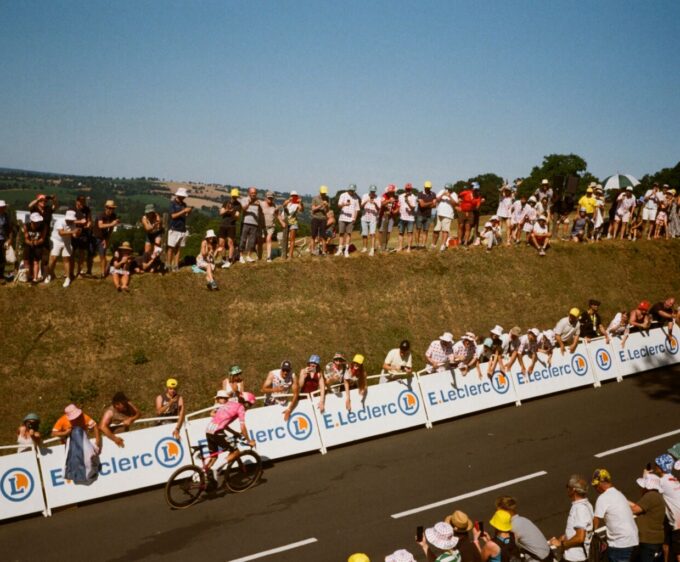
With the Tour de Femmes 2026 about to be in full swing, I spent part of last summer at the Tour de France to understand why that race still holds such a colossal place in cycling culture, and to imagine what the future could look like for women’s competitive cycling.
Intrsxtn Surf
Ever felt discouraged from surfing because you didn't match the stereotypical surfer image? Jessa Williams is breaking waves and boundaries. The surfing community that she has created is a symbol of empowerment, unity, and the celebration of diversity