
PART 2 : Changing The Chant
In 2022, Glorious examined how Hollywood turned one of the world's most demanding sports into one of its most enduring stereotypes. Four years later, cheerleading is still loud, still proud, and still smiling, but now mainly on its own terms. Documentaries, social media, and a new generation of filmmakers are finally closing the gap between Hollywood and reality.
By Glorious
In 2022, we published Cheerleaders: Changing the Chant, a story that became one of our most-read features. It asked a simple question: how had one of the most demanding sports on the planet become one of the most misunderstood? The disconnect could hardly have been starker. On one side were athletes spending evenings throwing teammates several metres into the air, drilling tumbling passes until their wrists ached and rehearsing routines built on strength, trust and precision. On the other was the cheerleader handed down by popular culture: the pretty girl with pom-poms, the mean girl, the girlfriend, the object of desire, the punchline.

If we wrote that story today, we would still argue that cheerleading is misunderstood, but for different reasons. Cheerleading itself has evolved dramatically. The image most people carry in their heads has not. That image has always been contradictory: athletic but not intimidating, feminine but physically powerful, aspirational but never quite serious. Few female athletes have spent so long balancing on that tightrope. Cheerleading has been celebrated for its spectacle while dismissed for the very qualities that make it distinctive. It has also spent decades having to explain itself. That, finally, is beginning to shift.
In England, cheerleading received official recognition as a sport in 2025, a landmark moment after years of campaigning by SportCheer England. The organisation estimates there are now more than 89,000 participants across the country, most of them girls and young women who remain in organised sport through adolescence, an age at which participation in many other activities drops sharply. Recognition did not make cheerleading legitimate; it simply acknowledged what athletes already knew. But recognition on paper is one thing. Recognition in culture is something else entirely.

Ask someone who has never attended a competition to picture a cheerleader and the image arrives instantly: pleated skirt, bright lipstick, megawatt smile, American football somewhere in the background. For most people, that picture wasn’t built in a sports hall or a local club- it was built in the cinema.
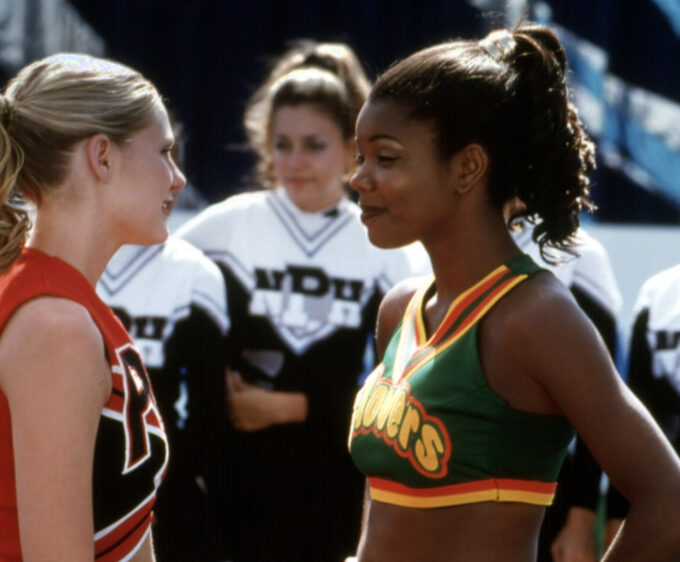
Bring It On, Peyton Reed’s 2000 cheerleading comedy starring Kirsten Dunst and Gabrielle Union, deserves enormous credit for treating winning as something that mattered. Its athletes were obsessive, competitive and ambitious, and success came through repetition, teamwork and discipline rather than luck. Even its central rivalry explored race and cultural appropriation in ways that still feel remarkably prescient. At the same time, it helped lock in a particular version of the cheerleader. The characters were still defined by popularity, appearance and desirability. The routines mattered, but so did the crop tops. Cheerleading was undeniably athletic, but it was also presented as a performance designed to be watched. That tension between sport and spectacle would shape almost everything that followed.

Hollywood did the rest. Need to establish the social hierarchy of an American high school? Add the cheer squad. Need a love interest? Make her captain. Need someone for audiences to envy, resent or fantasise about? Hand her pom-poms. From American Beauty, Sam Mendes’ 1999 suburban drama, to Glee, Ryan Murphy’s musical comedy series that ran from 2009 to 2015, the archetype barely changed. The uniforms evolved. The names were different. The character remained largely the same.
Stereotypes survive because they’re useful. They save writers time; we understand the “cheerleader” before she has spoken a single line. The problem is what happens when the shorthand becomes more recognisable than the people it claims to represent. Over the past two decades, the sport itself has moved on, developed, professionalised. Popular culture has been slower to follow. In a lot of films, you still know who the cheerleader is before you even know her name.
relentless

Meanwhile, away from the screen, something else was happening. It didn’t start in a cinema or on a TV schedule, it started on people’s phones. As social media platforms grew and video became central to them, millions of viewers began encountering cheerleading in a different way. Clips from the ICU World Championships, The Cheerleading Worlds and collegiate competitions started attracting enormous audiences. Basket tosses sent athletes soaring through the air. Tumbling sequences looked more at home on a gymnastics floor than on a sideline. Entire pyramids collapsed and were rebuilt in seconds. The comments beneath those videos became almost as familiar as the routines themselves: “I didn’t know cheerleading looked like this.” “I thought they just danced.” “This is insane!”


Those reactions reveal something important. The stereotype survived for so long not because it was especially accurate, but because most people had never actually seen the sport for themselves. Once they did, the old image began to look oddly flimsy, less like a description and more like a costume that had been worn for so long nobody thought to ask what was underneath.
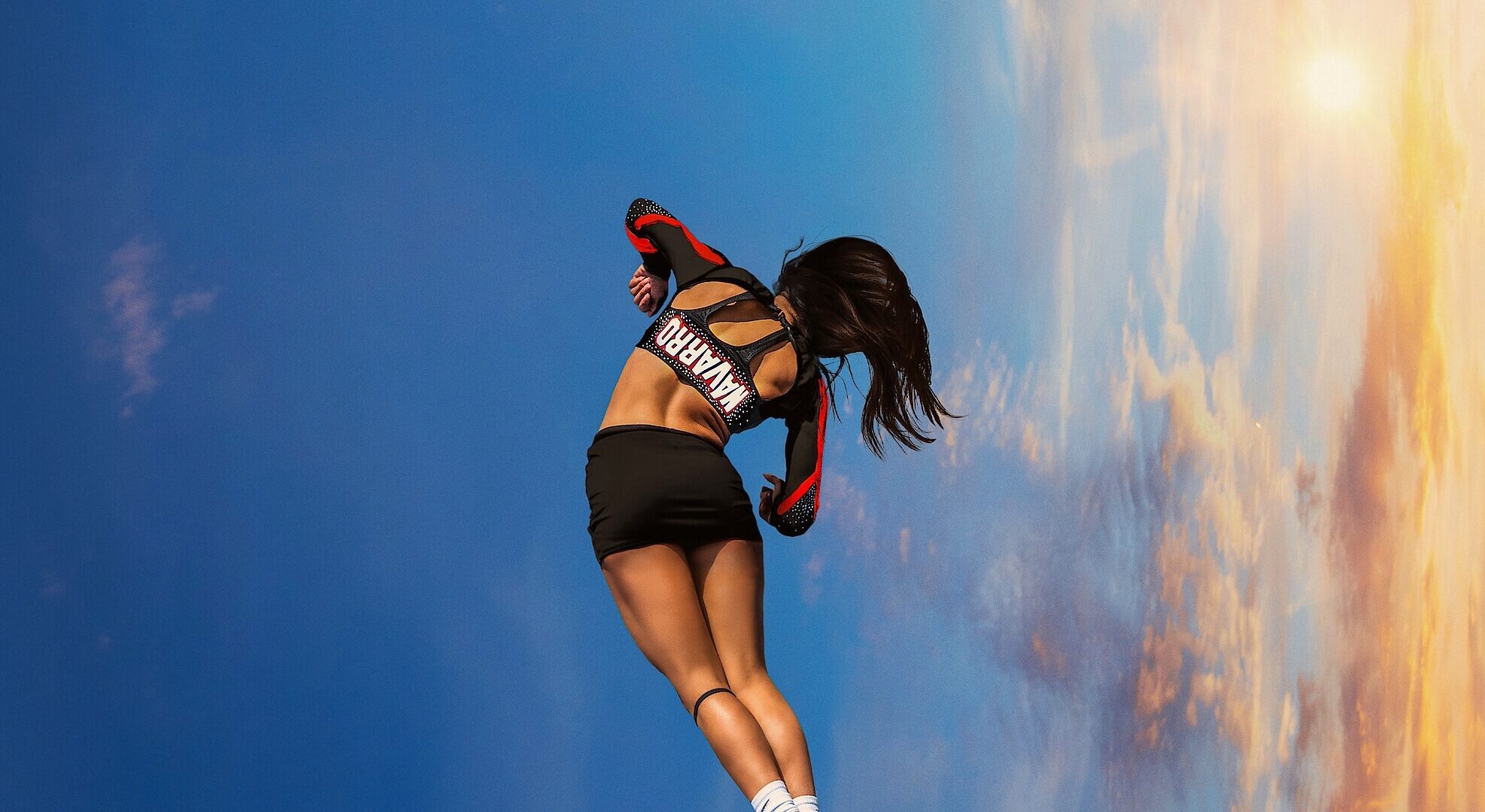
Then came the streaming era, which took that raw, shaky phone footage and turned it into prestige television. Netflix’s Cheer, the 2020 docuseries created by Greg Whiteley, focused less on smiles than on sacrifice, following Navarro College as they prepared for Daytona. Audiences saw relentless repetition, brutal training schedules and athletes prepared to risk serious injury for two-and-a-half minutes on the mat. People still debated whether cheerleading was a sport, but they could no longer argue it wasn’t physically demanding. For many viewers, this was the first time cheerleaders had been framed primarily as athletes rather than as supporting characters.
Stereotypical

If Cheer foregrounded pain, effort and risk, another Netflix series pushed the conversation sideways. America’s Sweethearts: Dallas Cowboys Cheerleaders (2024), a behind-the-scenes docuseries produced with the organisation, looked, at first glance, like another glossy production. Instead, it revealed the extraordinary standards expected of the women who wear one of the most iconic uniforms in sport: gruelling auditions, endless rehearsals, relentless scrutiny over appearance, public criticism and remarkably modest pay. Former cheerleaders spoke openly about juggling multiple jobs while representing one of the wealthiest sporting organisations in the world. By 2025, reports suggested substantial pay increases after years of campaigning, changes that many viewed as overdue rather than revolutionary, including a widely reported 400% raise for game fees.
The question people started asking was no longer “are they really athletes?” It was “why have they been valued so little for so long?” The Dallas Cowboys Cheerleaders sit at a peculiar intersection of sport, entertainment and commerce. They are marketed as symbols of excellence, yet for decades the conversation around them has focused far more on appearance than on athletic ability. Netflix’s America’s Sweethearts did not dismantle that image, but it did complicate it. It asked audiences to look beyond the perfectly synchronised kickline and consider the labour beneath it: the training, the choreography, the fitness standards and the responsibility of representing one of the biggest sporting brands in the world. Suddenly, pay packets and contracts were part of the cheerleading conversation too.

This is the landscape in which cheerleading finds itself today. The conversation has matured, but it hasn’t entirely moved on. Part of the challenge is that “cheerleading” still refers to two very different things. Competitive cheer and professional sideline cheer share a common history, but they have evolved into distinct disciplines with different purposes, audiences and demands. One exists to compete. The other exists to entertain. They overlap visually, not structurally, and yet they are still treated as interchangeable, rather like confusing Olympic artistic gymnastics with a West End dance production simply because both involve movement and music.

That misunderstanding continues to shape public perception. Competitive cheerleading has become one of the most technically demanding team sports in the world, judged on difficulty, execution and synchronisation. Athletes perform tumbling passes, partner stunts and pyramids that demand extraordinary precision, strength and trust. Injury studies have consistently highlighted the risks involved at elite level, with concussion and upper limb injuries among the most common. None of that sits comfortably alongside the enduring stereotype of the carefree high-school cheerleader whose biggest concern is whether she gets asked to prom. She may appear on screen in a pleated skirt, off screen, someone her age might be learning to back-tuck out of a cradle.
So why has this stereotype proved so stubborn when so many others have faded? Other women’s sports have undergone significant cultural reappraisals over the past decade.
Women’s football has shed its novelty status. Women’s boxing is no longer treated as a gimmick. Skateboarding, surfing and women’s rugby have all benefited from audiences seeing elite athletes on their own terms. Cheerleading, however, remains oddly frozen in time.
Part of the answer lies in the way the cheerleader has functioned within popular culture. She has become less a character than a symbol, a piece of visual shorthand for popularity, desirability and the social hierarchy of the American high school. Writers reach for her because audiences instantly understand what she signifies. Whether she appears in a horror film, a teen comedy or a television drama, her role is often established before she says a single word. The story doesn’t have to earn her presence; it borrows meaning from the archetype.
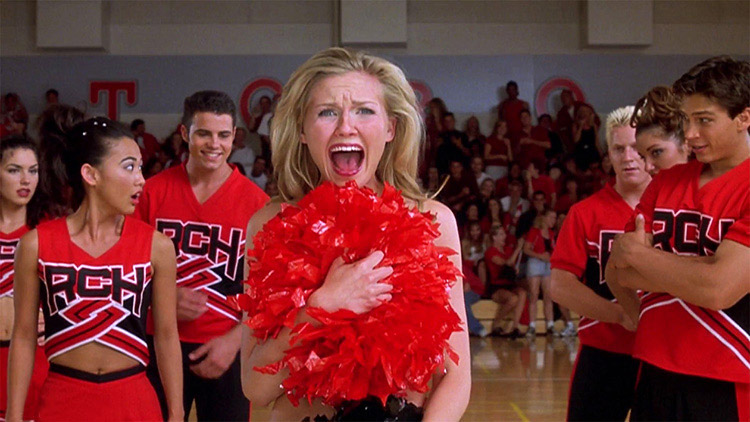

In recent years, some filmmakers have started to prod at that shorthand rather than simply rely on it. Bottoms, Emma Seligman’s 2023 queer high school fight-club comedy starring Rachel Sennott and Ayo Edebiri, plays with the familiar hierarchy of the American high school and refuses to treat its cheerleaders as ornamental. They are still beautiful and desirable, but they are no longer passive prizes waiting to be won. They have personalities, flaws and agency, and the film gleefully mocks the conventions that earlier generations of teen films helped establish. The joke is no longer just about the cheerleader’s behaviour; it is about the fact that the audience recognises the trope well enough to see it being skewered. It’s self-awareness as punchline.
That kind of self-awareness is becoming more common. Directors and writers increasingly understand that audiences recognise these tropes, which gives them permission to subvert them. The mean cheerleader has become almost too obvious. The popular blonde captain no longer feels particularly original. Yet even when films attempt to undermine those clichés, they rarely abandon them altogether. The cheerleader has become part of the visual language of American cinema. It is easier to reference than to replace, and so the image keeps circulating even as the sport itself keeps changing.

None of this would matter quite so much if cheerleading were simply a fictional device. But for decades, the stories we told about cheerleaders were never really about cheerleading at all. They were stories about femininity, popularity and adolescence, with cheerleading providing the costume. The athletes themselves were often incidental. That pattern will be familiar to anyone who has followed women’s sport more broadly. Time and again, female athletes have found themselves defined not by what they do, but by what they represent. Their appearance, personalities and relationships have frequently received more attention than their performances. Cheerleaders have perhaps experienced this more acutely than most because their sport has always existed so visibly alongside entertainment. The smile became more recognisable than the skill. The uniform became more famous than the training required to wear it.
tropes

In 2022, we argued that the chant needed to change because the conversation surrounding cheerleaders had become disconnected from the reality of the sport. Looking back now, that argument still feels true. What has changed is where that conversation is taking place. It is no longer driven solely by Hollywood or television. Athletes are increasingly telling their own stories, documentaries are asking more difficult questions and audiences are becoming more willing to challenge long-held assumptions. A teenager can now watch an elite routine minutes after it finishes, hear directly from the athletes involved and gain a more accurate understanding of the sport than generations before ever could.
Whether that amounts to a genuine cultural shift remains open to debate. Stereotypes rarely disappear overnight. They fade gradually, replaced not by a single defining moment but by hundreds of smaller ones: a documentary that reveals uncomfortable truths, a competition routine that goes viral, a governing body securing official recognition, a young girl deciding to join her local club because she has finally seen someone who looks like an athlete rather than a cliché. Taken together, those moments begin to change not just what we see, but what we expect to see when we hear the word “cheerleader”.

If there is a lesson in cheerleading’s past few years, it is perhaps that visibility and understanding are not the same thing. For decades, cheerleaders were everywhere, in films, television, adverts, music videos and on the sidelines of some of the world’s biggest sporting events. They were instantly recognisable, yet the sport itself remained largely invisible. Familiarity created the illusion of understanding. Only when people began to watch what cheerleaders actually do, and to listen to how they talk about their work, did that illusion start to crack.
Cheerleading has not suddenly become something different. The routines have become harder, the athletes stronger and the pathways more professional, but much of what makes the sport compelling has been there all along.
What has changed is the lens through which we view it. The conversation has moved beyond the uniform. There is still work to do, and the stereotype will almost certainly outlive another generation of films and television shows, but it becomes a little less convincing every time someone sees an elite routine for the first time or hears a cheerleader describe the reality behind the performance.
In 2022, we asked why one of the world’s most demanding sports remained one of its most misunderstood. Today, that question feels less like an accusation and more like an invitation: to watch more closely, to listen more carefully, and to allow the people inside the sport to define it for themselves.
We’d love to hear how your view of cheerleading has changed. Join the conversation and let us know your thoughts on Instagram at @glorioussport.
Title image credited to Cheer, Netflix, 2020,
Editorial Design by this is root
Share This Article
If you love this you’ll also love...
Cheerleaders: Changing The Chant
For too long the cheerleader has been regarded as a ditzy, sexualised, female figure of fun. Glorious takes a peek at the history of cheerleading and declares it’s time for positive change
Higher Love
It took a 1,454-foot free climb to the top of the Empire State Building to secure an unforgettable proposal. But the arrest is only the latest chapter in Angela Nikolau and Ivan Beerkus' extraordinary love story.
#Fitspo
Are online fitness influencers masters of deception or authentic role models? We deep dive into the rise of #deinfluence with imagery generated by an AI bot's response to #fitnessgoals
Mary, Quite Contrary
Kim Kardashian may have recently swerved Martin Brundle on the Monaco grid, but Mary McGee stopped him in his tracks. As Le Mans returns this weekend, we revisit the life of a motorsport original who raced cars, conquered Baja and made history on two wheels.