Who Approved That?!
After Callaway and Good Good Golf’s controversial new ad was pulled, we look at what happens when sports brands get marketing to women spectacularly wrong. And why provocative creative and seriously questionable judgement aren’t always the same thing.
By Natasha D
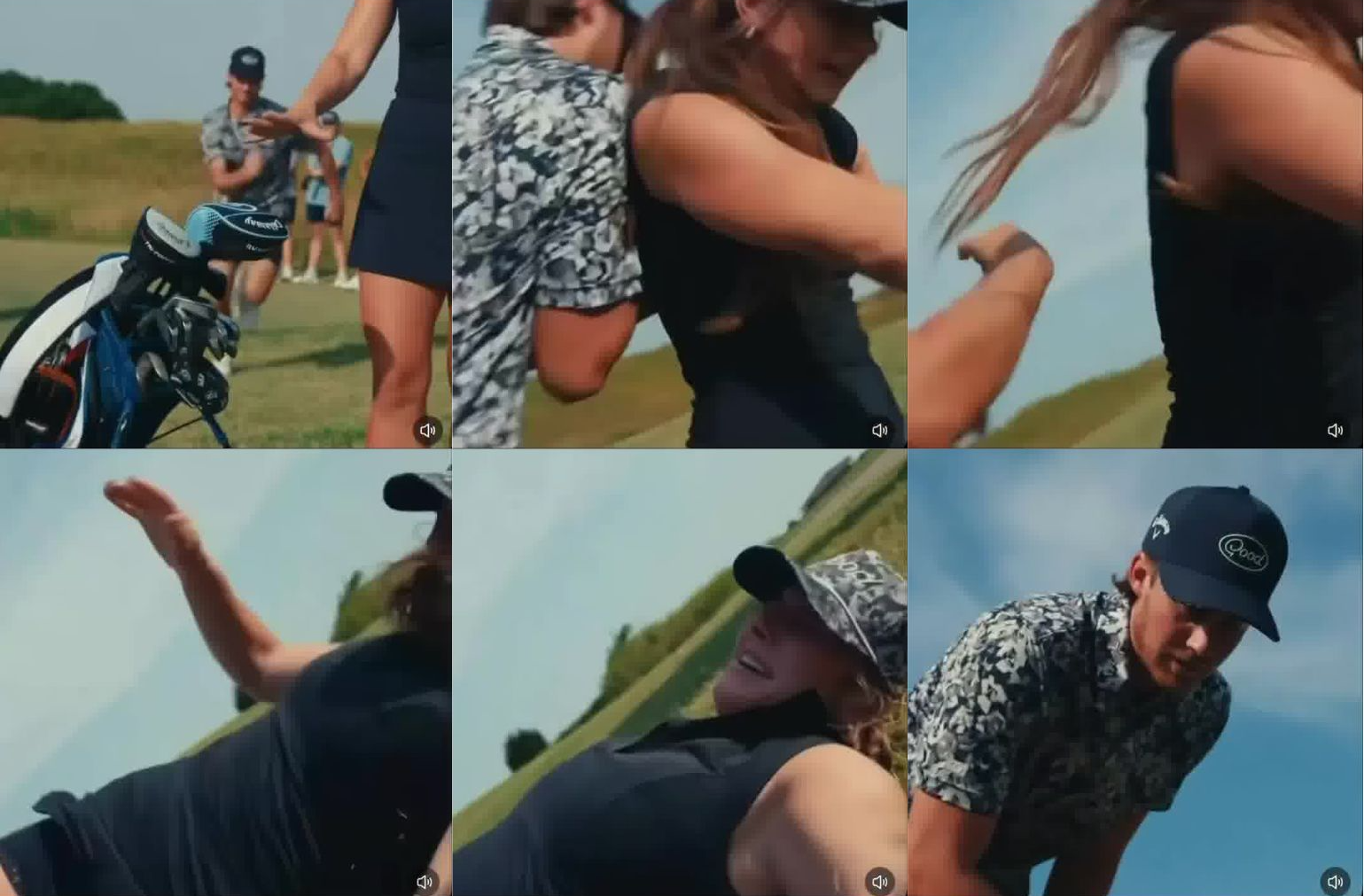
On 21 August 2026, Callaway and Good Good Golf released an advert for their new co-branded Quantum Max Good Good driver. It did not stay online for long. The premise? Good Good co-founder Garrett Clark sees former Division I golfer and Good Good Girls member Alexis Miestowski reaching for his new Callaway driver, runs at her and knocks her to the ground. He then stands over her and tells her, “Do not touch my new driver.”
Seriously.
This is an advert that got made and released.

Apparently intended as a parody of the horror film Obsession, the film was created and produced by Good Good Studios. But Callaway was not an innocent bystander. CEO Chip Brewer has since confirmed that Callaway approved it before publication. “That approval should never have happened,” he said. Both companies have apologised, investigations have been announced and approval processes are being reviewed. Callaway’s own statement goes further, saying the company is “unequivocally against discrimination, domestic violence, or threatening behaviour of any kind”. Which rather underlines what we’re actually looking at here. This isn’t just a joke that didn’t land. The imagery evokes domestic abuse. So, who on earth approved this?!

We should probably declare an interest here. Alongside the editorial you see on Glorious, we deliver full-service creative for our brand partners, developing campaigns around women and women’s sport. So we get the process. Ideas get pushed, pulled apart, loved, hated, approved and disapproved. Sometimes the thing everyone thought was brilliant on Tuesday looks considerably less brilliant by Thursday. We also know that once something reaches the internet, almost anything can become controversial. Sometimes reasonably, sometimes less so. Making work nobody could possibly object to isn’t necessarily the answer either. It would probably result in some very boring creative.

But creative work goes through people, usually quite a lot of them. The quality of that process depends on the experience and judgement of the people making those decisions. Someone needs enough reference, knowledge and confidence to push an idea when it deserves pushing, challenge it when it doesn’t and, occasionally, kill it altogether.

That feels particularly relevant here because Good Good isn’t speaking into a vacuum. It has built an enormous digital following, much of it made up of young men and boys who follow its players, content and version of golf. Even if the film was intended entirely as a joke, what exactly was that joke saying to them about women in the game? And beyond that, there is an even more basic advertising question. What was it supposed to make anyone think or feel about the product? Did somebody genuinely believe watching a woman being floored would make people want to buy the driver?
Good Good isn’t a scrappy YouTube channel anymore either. In March 2025 it raised $45 million from more than 50 investors, with the money earmarked partly for expanding its media operation and content creation. Good Good CEO Matt Kendrick said he wanted fans to see “more high-quality content”. With that kind of investment, you’d expect more than bigger budgets and more output. You’d expect experienced creative people with the judgement and cultural reference to know when an idea needs pushing, and when it simply isn’t good enough. Because this is what bottom-of-the-barrel creative looks like when that judgement is missing.
The handling afterwards hasn’t exactly helped. Good Good’s public apology was posted to Instagram Stories, meaning it disappeared after 24 hours, while its main grid carried on as usual with no acknowledgement of what had happened. The brand may have moved on. Judging by the comments underneath its subsequent posts, plenty of its audience hasn’t. Perhaps some of that $45 million might be usefully directed towards PR.
There is controversial creative, and then there is wondering how something made it through the room in the first place. Callaway isn’t the first sports business to discover the difference. In November 2025, Sky Sports launched Halo, a TikTok channel created specifically for young female sports fans. It described the new platform as Sky Sports’ “lil sis”, promising to bring together sport, culture and community. Three days later, it was gone. In between came pink graphics, references to matcha and hot-girl walks, and content that seemed to suggest young women required sport to be translated into an entirely different language before they might be interested in it. The reaction was swift. Critics called it patronising and sexist. Sky pulled the channel and admitted, “We didn’t get it right.”
uncomfortable
The interesting thing about Halo is that the intention was almost certainly the opposite. Sky had correctly identified something the entire sports industry now knows. Women, and particularly younger women, represent an enormous and growing sports audience. It wanted to speak directly to them. Somewhere between that insight and the finished product, however, “young female sports fan” became a personality type. It is a familiar problem in marketing to women.

Recognising that women are an important audience is not quite the same thing as understanding that audience. Growing the audience for women’s sport is something we care rather a lot about at Glorious, but that doesn’t mean dressing it in pink or falling back on the old “you can do anything” school of female empowerment. The interesting bit is finding different ways into sport for people who haven’t traditionally seen it as being for them.
There is also a danger in drawing too simple a lesson from any of this, because controversy does not automatically equal bad creative. When Nike unveiled its Team USA athletics kit ahead of the Paris Olympics in 2024, one particular women’s bodysuit attracted rather more attention than Nike might have anticipated. Its extremely high-cut design prompted US long jumper Tara Davis-Woodhall to comment, “Wait my hoo haa is gonna be out?!” The image travelled quickly and so did the criticism. Sexist. Impractical. Who designed this?

Except the photograph wasn’t the whole story. Nike had created dozens of apparel pieces and multiple competition options for athletes, including shorts and less revealing designs. Olympic pole vaulter Katie Moon subsequently pushed back against the criticism, explaining that female athletes had choices and that the briefs were, in fact, her preferred option. Davis-Woodhall herself later reconsidered after seeing the kit in person, saying, “It was the picture that did no justice!” What initially looked like another example of a brand deciding what women should wear was rather more complicated. The athletes themselves had been given options. Same internet, same immediate outrage, rather different answer.

Then there are campaigns designed to make us uncomfortable. During the 2022 men’s World Cup, Women’s Aid took perhaps the most recognisable phrase in English football and changed a single word. “HE’S COMING HOME.” Suddenly, “It’s Coming Home” wasn’t about football. The campaign drew attention to research showing that reports of domestic abuse rise around England matches, turning a phrase associated with the excitement of a major tournament into something threatening. For some people, the campaign was uncomfortable. That was precisely why it worked. You stopped, looked again and understood. The discomfort wasn’t something the creative team had accidentally stumbled into after pressing publish. It was the creative idea.
That distinction matters, particularly as brands become increasingly nervous about getting things wrong. Creative should be allowed to provoke. It should be allowed to divide opinion, make people uncomfortable and occasionally annoy them. Women aren’t a single focus group waiting to collectively approve the next campaign. What one woman finds funny, another might find offensive. What one finds empowering, another finds patronising. Age, culture, experience and context all change how the same piece of work lands. Sometimes the internet spots a genuine problem. Sometimes it decides there is one before bothering with the context.

Golf has spent years talking about growing the game, and women are doing exactly that. Female participation is rising, investment is following and brands increasingly understand the commercial importance of the female golfer. Which makes it all the more baffling when the creative suggests otherwise.
Callaway’s own corporate material says female participation in US golf has risen 46 per cent since 2019 and that women now account for 28 per cent of on-course golfers. The company sells equipment specifically for women, works with some of the world’s leading female golfers and has invested extensively in women’s golf. Good Good, meanwhile, has been making what its own marketing VP described as a “conscious effort” to grow its women’s business, including launching Good Good Girls and developing women’s apparel around its female talent. The problem isn’t that either company has failed to notice women. They very clearly haven’t.
Good Good’s response since the advert was pulled is significant. CEO Matt Kendrick has told staff the company will review its creative and approval processes, bring more perspectives into those decisions and, for the foreseeable future, personally review content released by its marketing and content teams. More substantially, Good Good says it will donate all proceeds from driver sales associated with the campaign to an organisation supporting women in its local community. At the time of writing, it has not chosen the recipient and says it is researching local organisations to determine where the money can have the greatest impact. Callaway, meanwhile, says it is conducting both internal and external investigations and has already changed its approval processes.
EXPECTATIONS
Those are meaningful responses, but they don’t answer the more interesting question of how the work reached the public in the first place. Women’s sports advertising doesn’t need to become an endless procession of slow-motion athletes accompanied by earnest voiceovers about barriers being broken, or the dated somewhat patronising idea that women need reminding they ‘can do anything if only they believe in themselves’. It can be funny, strange, stylish, irreverent, provocative and occasionally divisive.
Controversy isn’t necessarily a creative failure. Sometimes it is deliberate, sometimes the internet gets it wrong and sometimes making people uncomfortable is precisely the point. But there still has to be an idea worth defending. In this case, after the apologies, investigations, deleted film and promised changes, we’re still struggling to work out what that idea was. Or, more simply, why anyone thought this was a good idea in the first place.
Who on earth approved this?!
What do you think? When does provocative creative cross the line into plain bad judgement? Let us know your thoughts @glorioussport
Title image: Stills from the now deleted Good Good Golf x Callaway Golf Quantum driver campaign film, August 2026.
Editorial note: An extract from the original Good Good Golf / Callaway Golf campaign is reproduced in this article for the purposes of criticism and review. All rights in the original footage remain with their respective rights holders.
Share This Article
If you love this you’ll also love...
Textured Waves
Chelsea Woody is a surfer, registered nurse, filmmaker and co-founder of Textured Waves. From challenging representation in surfing to raising awareness of maternal health, she's using the ocean as a platform for change.
Mary, Quite Contrary
Kim Kardashian may have recently swerved Martin Brundle on the Monaco grid, but Mary McGee stopped him in his tracks. As Le Mans returns this weekend, we revisit the life of a motorsport original who raced cars, conquered Baja and made history on two wheels.
Cheerleaders: Changing The Chant
For too long the cheerleader has been regarded as a ditzy, sexualised, female figure of fun. Glorious takes a peek at the history of cheerleading and declares it’s time for positive change

Iris Slappendel
Halfway up a mountain at the Tour de France Femmes, it’s not the helicopters circling overhead waiting for the peloton that makes you stop, but a group of women, loud, coordinated, colourful, all chanting one name.