Solar Eclipse
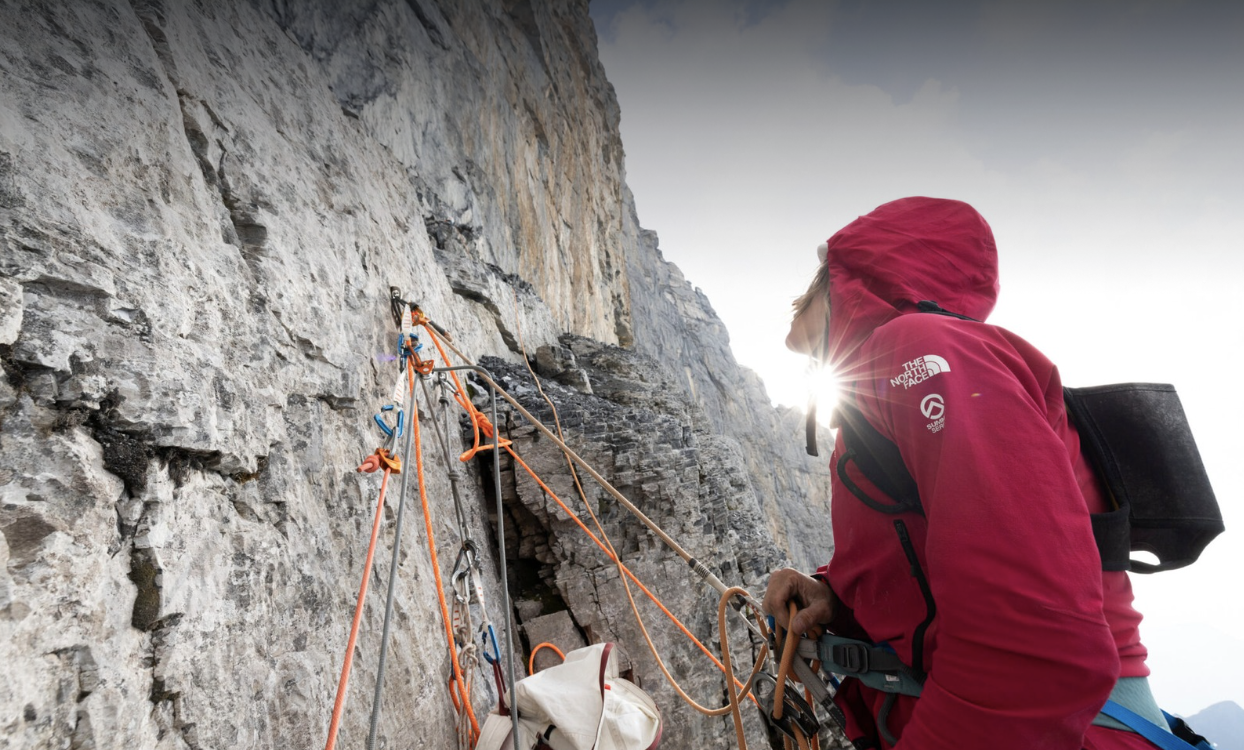
For 13 nights, Fay Manners lived on the North Face of the Eiger while creating a route nobody had climbed before. The result was Solar Eclipse, and a place in mountaineering history as the first British woman to open a new route on the face.
By Glorious
There are easier places to spend a fortnight than the North Face of the Eiger.
For 13 nights this summer, British alpinist Fay Manners lived hundreds of metres above the ground on one of the most famous faces in mountaineering. Alongside Swiss climber Roger Schäli, she was there to establish Solar Eclipse, a new 900-metre route on the Eiger’s North Face comprising 33 pitches of previously unclimbed terrain.
Manners, who has now made 23 first ascents around the world, became the first British woman to open a new route on the Eiger’s North Face. But doing so meant heading onto the mountain without knowing exactly where the line would lead, what they would find or whether their idea would get them to the top.
We spoke to Fay about creating something where nothing existed before, living on the side of a mountain for nearly two weeks, fear, partnership, a perfectly timed solar eclipse and the surprisingly practical question of how on earth you get back down!

Opening a new route sounds slightly mad to anyone who doesn’t climb. What does it actually involve when there is quite literally no route to follow?
Opening a new route is a very creative process. You are essentially looking at a huge piece of rock and trying to find a line through it that nobody has climbed before. You have to imagine where the climbing might go, where the rock might be good, where you might be able to protect yourself and whether the whole thing will actually come together.

There is a huge amount of uncertainty. You don’t know what the rock will be like, whether there will be protection, how hard it will be, or even whether the line you imagined will work. You carry equipment for all the possibilities: big cams, small cams, pitons, a drill, because you don’t know what you are going to find until you are there.
And then there is the biggest uncertainty of all. You don’t know if you can get to the top!
On an established route, someone has already proved that the line is possible. When you open something new, you have to be comfortable with the possibility that you might fail, not just that you might not be strong enough, but that the route itself might not go. You have to believe in an idea before there is any evidence that it will work.
Thirteen nights on the North Face is a long time. What does “home” look like up there, and what starts to feel weirdly normal?
Home becomes a tiny portaledge suspended in the middle of this enormous wall.
You wake up every morning to one of the most beautiful views in the world and go to sleep under the stars. It is incredibly peaceful, but there is also a strange loneliness to being so far away from everything. Somehow, that isolation becomes comforting.
Even making coffee becomes exciting. Once you’ve finished it, you have to leave this little place where you feel safe and go back onto the wall, with absolutely no idea what the day is going to bring.
The portaledge becomes a little world. If I get out of bed, Roger feels it. If he moves, I feel it. Going to the toilet becomes something you have to plan. Everything has to be organised carefully so the things you need are accessible, while still leaving enough room to sleep.
What surprised me most was that afterwards, I missed it. I missed the silence. I missed waking up with nothing around me except rock, sky and the person beside me. The world seemed to disappear, and somehow that felt incredibly freeing.

Let’s talk food. What do you eat for 13 days on the side of a mountain, and what were you dreaming about eating by the end?
A lot of dried food and whatever we chose to carry.
I love chocolate, so that was definitely a good part of it! Roger is Swiss German, so he had brought Emmentaler cheese and cervelat sausage, which he kindly shared with me.
But after a while I started craving something completely different: green vegetables. Broccoli. Salad. Anything fresh and full of vitamins.
We were getting enough calories, protein and sugar to keep going, but I felt like my body was asking for something more nourishing. By the time I came down, I didn’t really want another chocolate bar. I wanted a huge plate of fresh, healthy food. It was a funny reminder that your body knows what it needs, especially when you have pushed it that far.

You took a 10-metre fall during the climb. What happens in your head immediately afterwards, and how do you persuade yourself to go again?
When I landed, my first thought was very practical: Are my ankles okay? Have I hurt myself?
I realised I was fine. Then I looked at Roger, and he actually looked more frightened than I felt.
There is a strange moment after a fall where neither of you really wants to go back onto the wall. You know it is going to be hard, and that there is a possibility of falling again. For a few moments, it would be very easy to let that fear grow.
But I knew myself. If I waited too long, I might start imagining all the things that could go wrong and allowing the fall to become bigger in my head than it actually was.
So after a couple of minutes, I went again.
For me, sometimes courage isn’t about not being frightened. It’s about knowing when you need to move before fear has time to make the decision for you.
peaceful
Are you frightened when you climb, and have you learnt to understand fear differently?
Of course I am frightened sometimes. It depends completely on where I am on the climb and what the consequences of a fall might be.
If I’m a long way above my last piece of protection and know a fall could be serious, I become much more aware of the risk. I might climb more cautiously, down-climb, question myself or think for too long about what to do next. I concentrate on controlling my breathing, staying calm and not getting too pumped.
If I know my protection is good and that I could take a long but safe fall, the fear is very different because the consequences aren’t as serious.
When you’re opening a new route, you have to become comfortable with being uncomfortable! Falling is often part of the process. If you never fall, it can mean you are staying completely within your limits rather than discovering where those limits actually are.
I think fear is also something that changes with experience. When you first start climbing, so much of it feels completely out of your control. As you become more experienced, you learn to read situations and understand what is likely to happen before it does.
Something can look terrifying when you don’t understand it. But once you develop the skills and experience to navigate it, you realise that what looked impossible from the outside is actually something you can learn to handle.

There’s something wonderfully creative about looking at a wall and seeing a route that doesn’t yet exist. How much of opening one is physical ability, and how much is imagination and instinct?
I’d say it’s about 50/50.
It starts with creativity. You have to look at the rock and imagine something that doesn’t exist yet. But eventually that idea has to meet your physical ability.
The technical side goes much deeper than simply being able to climb a certain grade. It comes from years of experience: reading rock, knowing what is solid and what is loose, knowing what makes a beautiful climbing line and understanding where protection will actually hold.
There is a whole language you develop with the rock. You start to see things instinctively: a crack that might take a piece of protection, rock that looks beautiful but isn’t trustworthy, or a movement that might unlock an entire pitch.
Strength matters. Technique matters. But so does imagination. You need to be able to see something before it exists.


You named the route Solar Eclipse after watching the event from a portaledge hundreds of metres above the ground. What was that moment actually like? And please tell us you had eclipse glasses?!
We were actually sitting on the portaledge eating dinner when we saw it.
I wasn’t even thinking about the eclipse. We’d already been working on the route for more than ten days, so it had almost disappeared from my mind. Roger reminded me it was about to happen because we started noticing the colours in the sky becoming softer.
The light was incredible. We were sitting there, suspended hundreds of metres above the ground, looking out at this incredible landscape as the light changed around us. I felt incredibly privileged to experience something from such an extraordinary place.
No, we didn’t have eclipse glasses!
The first thing my mum asked when I told her I’d opened a new route on the Eiger and named it Solar Eclipse wasn’t about the climb. She was worried about my eyes.
She was more concerned about the eclipse damaging my eyesight than me climbing the Eiger North Face!
creativity
You and Roger spent nearly two weeks together on a wall with very few distractions. What on earth do you talk about for 13 days, and did you come away knowing each other differently?
We talked about the route almost all the time. What we’d climbed that day, where we should go tomorrow, how we should approach the next pitch, the style we wanted to climb it in and what grade we thought the pitches might be.
But we also had more intimate conversations about our lives and careers as athletes, and what it means to dedicate so much of yourself to a sport.
Roger grew up in the mountains and has been an athlete for much longer. I grew up in England, playing football in the fields with my brother. The mountains weren’t in my backyard and I came to climbing much later.
And yet somehow we had arrived at the same place. That was one of the things I valued most, realising that two people can come from completely different beginnings and still find the same passion, obsession and love for something.

You’re the first British woman to open a new route on the Eiger’s North Face. Does being the first matter to you?
It does matter to me.
The Eiger North Face is one of the most prestigious walls in the world. Opening a new route there carries enormous weight, and knowing that my name is now part of that history is something I feel genuinely proud of.
Being a woman matters. Women opening new routes on walls like the Eiger is still rare.
Representation matters because sometimes the most powerful thing you can give someone is the feeling that maybe I could do that too.
Being British matters too. I grew up in Bedfordshire. These mountains weren’t around me. I didn’t grow up believing that this was what people like me did. I found climbing later in life and ended up on one of the most famous walls in the world, creating something that hadn’t existed before.
I hope it reminds women, and really anyone, not to let other people decide the size of their ambitions. Sometimes we put boundaries around ourselves before we’ve even tried.

After 13 days of working towards the top, what does finally getting there actually feel like? Is there a huge moment of celebration, or does your brain immediately move on to what comes next?
When we reached the top, I was almost immediately thinking about the route again.
I was thinking about how we could improve it, clean it and leave it in the best possible condition for the people who might climb it after us. I wanted to feel proud not only of having opened it, but of what I’d left behind.
I like the idea that years from now, other climbers will come back to the Eiger, climb the line we created and have their own experience on it. That is a different kind of legacy.
It wasn’t until I came home and was surrounded by my family and friends that I really understood what we’d done. They made me stop and take it in. They reminded me that I didn’t have to immediately think about the next challenge or how I could make it better. I could simply be proud of myself.

Once you’ve climbed the Eiger, how on earth do you get back down?!
We walked down the west face.
The first ascent of the Eiger was made in 1858 via the west side, so there is an incredible sense of history in descending that way.
For us as climbers, it is a relatively straightforward scramble, but that doesn’t mean you can switch off. You’re still high on a huge mountain, carrying a lot of equipment, and you have to stay alert and make good decisions.
On a mountain, you never really get to switch off until you’re safely down.
recovery
And then you’re home. After 13 nights living on a wall, how quickly can your body and brain adjust to normal life again?
The first thing I wanted was a shower.
Then I needed to hydrate and look after my body. My eyes were tired, my muscles were sore and I was dealing with cramps. Coming home wasn’t about immediately going back to normal, it was about recovery.
But the strangest part was that my mind didn’t come home as quickly as my body did. I didn’t sleep particularly well for the first few nights. I was still completely alert, still switched on, and I found it difficult to relax. After thirteen days of being constantly aware of the rock, the weather, the equipment, the route and each other, suddenly lying in a normal bed felt almost too easy.
And, strangely, I missed the wall. I missed the silence and the intensity. Coming home made me realise that sometimes the places that challenge you most can also become the places where you feel most alive.

Share This Article
If you love this you’ll also love...
Climbing Days
History often forgets the whispers of remarkable women. But today, we rediscover Dorothy Pilley, a pioneering climber who co-founded the Pinnacle Club and shattered expectations in a man’s world. Her great-great nephew Dan Richards, gives us a glimpse into her adventures.
Cape Epic
Kate Courtney has spent much of the past year doing things she didn’t expect. The two‑time world champion talks risk, rediscovering the fun in racing and returning to the brutal Cape Epic for her new Red Bull film Everything to Gain. What happened next surprised even her.
Glitter & Globes
In Lake Placid, in front of 35,622 fans, Jessie Diggins skied the last race of her career at the first Cross-Country Skiing World Cup Finals ever staged on American snow. We head to one of the most thrilling three-day moments women’s endurance sport has produced in years.
Run To Extremes
Breaking records and conquering mountains is commonplace for lawyer turned ultramarathon athlete Fernanda Maciel. We find out what drives her constant appetite for endurance sports