All The Gear, No Idea?
Chanel skis, Hermès boxing gloves and Dior Pilates equipment costing thousands. Luxury fashion is finding increasingly inventive ways to get involved in sport, just as its customers are starting to question what they're paying for. So who's buying all this stuff, and what are the big houses really after?
By Glorious
Who the hell is buying a Chanel padel racket?
And, more importantly, what exactly are they buying? A piece of sporting equipment, a status symbol, or an extremely expensive way of telling people they play padel?
Perhaps we’re missing the point entirely. Maybe it’s an objet d’art, something to display rather than use. A £5,000 racket might look rather lovely on a wall, particularly if you’ve never had any intention of setting foot on a court.

Fashion has supposedly grown tired of conspicuous logos. The enormous Balenciaga sweatshirts and head-to-toe Gucci monograms have lost some of their appeal. Quiet luxury arrived, everyone discovered beige, and suddenly looking expensive meant not looking as though you’d tried. Except sport never got the memo.
Sport has always been covered in logos. Nike swooshes, adidas stripes, sponsors across football shirts, branding on everything from tennis rackets to swimming caps. Nobody particularly questions it because branding is part of sport’s visual language. A logo on a sweatshirt might look vulgar. Put one on a tennis racket and it’s practically expected. And now luxury houses have spotted the opportunity.
We’ve written about this relationship at Glorious at considerable length. In Beyond the Hype, we explored the appetite for luxury sportswear collaborations, while The Long Game examined the growing influence of sport across the fashion industry. We’ve covered the runway shows, the designer football kits, the athletes and the trainers that have never been anywhere near a running track. And believe you me, I could write another 2,000 words on the subject. Hello, LOEWE and On, Cecilie Bahnsen and The North Face, and Balenciaga designing boxer Ramla Ali’s kit. There’s little point pretending fashion has only just discovered sport, although judging by the number of collaborations being announced, you’d be forgiven for thinking somebody had recently invented exercise.

The sporting accessories themselves are becoming increasingly difficult to ignore. Chanel’s latest collections include padel equipment and skis. Louis Vuitton sells padel rackets too. Dior has gone all-in on the business of wellness, offering yoga mats, Pilates rings, yoga blocks and enough high-end exercise accessories to furnish a boutique studio. Prada has tennis accessories and leather ball holders that somehow manage to elevate one of the cheapest objects in sport into something deserving of luxury accommodation. Saint Laurent and Prada have both experimented with table tennis because, apparently, there exists a customer demographic capable of looking at a perfectly serviceable ping-pong bat and thinking it would benefit from a fashion house logo.

Dior has even given the whole thing a name, Haute Wellness, extending its offering well beyond yoga mats and Pilates rings. And if you don’t fancy buying the equipment, you can always experience the Dior lifestyle at one of its spas, or book a workout at the fitness studio adjoining its spa at Paris’s Plaza Athénée. The house is now offering everything from exercise accessories to personalised wellness programmes and luxury retreats. It’s a rather impressive bit of brand diversification. Dior no longer just wants to dress you. It wants to look after your entire lifestyle, preferably at Dior prices.
There is something inherently funny about luxury sporting equipment because so much of it appears to be solving problems nobody knew existed. A yoga block helps you reach the floor. A tennis ball holder holds tennis balls. A ping-pong bat hits a er… ping-pong ball. There are limits to how much innovation can happen before you’re simply decorating a familiar object and charging four figures for the privilege. But laughing at the products slightly misses the point, particularly when you consider what they’re doing for the brands behind them.
novelty
I’ve spent enough years working in fashion to know that Chanel isn’t trying to become Wilson. Prada isn’t attempting to overthrow Head. Dior’s future does not depend on dominating the global yoga block market. These products are produced in tiny quantities, aimed at tiny audiences, and scarcity is part of the appeal. Luxury houses have always made strange things for wealthy customers. What’s different is how effectively these things travel. A handbag appears in a fashion magazine. A Louis Vuitton padel racket appears in fashion magazines, sports websites, business publications, TikToks, Instagram reels and group chats full of people asking who on earth would spend that much money on it. The product is often secondary. The conversation isn’t. And the fact that I’m writing about designer sporting equipment for an audience that might never otherwise give Chanel a second thought is proof that the exercise is working.

That’s particularly relevant at a moment when luxury fashion is having what can politely be described as an uncomfortable period of self-reflection. After years of relentless price increases, some of the industry’s biggest names are discovering that customers are no longer willing to accept ever-rising prices simply because a familiar logo is attached. Consumers are asking harder questions about quality and value. Independent designers are attracting attention. Experiences increasingly carry more social currency than possessions. Luxury remains enormously powerful, but it feels less culturally dominant than it once did, which may explain why so many of its biggest names are attaching themselves to activities that other people have already made desirable.

Of course, who’s buying all this depends enormously on where they’re buying it. The luxury customer in London isn’t necessarily shopping like the luxury customer in Shanghai. According to McKinsey’s State of Luxury report, wealthy American shoppers are becoming more interested in challenger brands, while Chinese consumers continue to place greater value on established names and brand authority. Luxury sporting equipment isn’t necessarily aimed at the wealthy Londoner who pairs Zara trousers with a Celine coat. It may appeal more to customers for whom luxury extends from the wardrobe to the ski equipment, gym bag and tennis racket.

China is an especially interesting market to consider. As wealth and participation in fitness and wellness continue to grow, it’s not difficult to imagine the appeal of a luxury house that can outfit every corner of your life. If your wardrobe is Fendi, why shouldn’t your ski jacket be Fendi too? And if your child is playing tennis at Dulwich College or King’s College School, those prestigious London schools whose names now adorn international campuses across Asia, why wouldn’t you send them with a Gucci racket case and a set of designer tennis balls? Even British private education has become an international luxury brand, after all. The equipment becomes another part of the uniform, another signal that you belong. And I’d imagine the big houses know exactly how attractive that proposition can be to customers who aren’t buying the occasional luxury item but an entire luxury lifestyle.
Pick almost any modern lifestyle obsession and luxury fashion can be found hovering nearby with a capsule collection, collaboration or accessory. Running clubs have become social hubs. Wellness has become a personality. Reformer Pilates has waiting lists. Tennis is enjoying another moment in the sun. Cycling, recovery, longevity and whatever biohacking trend Silicon Valley has discovered this week all come with their own aesthetics, communities and status markers.
signals
Watching luxury fashion enthusiastically embrace whichever activity currently occupies a certain corner of the cultural imagination can occasionally feel like discovering someone has just become obsessed with a television series everyone else finished two years ago. Then again, perhaps that says more about the rest of us than it does about them.

Trend cycles tend to look different when you’re rich enough to ignore them. Most people have to book a court. The customers luxury brands are targeting may be deciding whether they’d prefer the padel court or the helipad on the upper deck. A tennis court requires serious real estate, whereas a padel court is much easier to accommodate on a superyacht. Suddenly the Louis Vuitton racket case and Chanel padel set start making a bit more sense. Not because padel is necessarily the hottest thing in culture, but because the people buying £7,000 sporting accessories are probably living in a slightly different version of culture altogether. And if you’ve installed a padel court on your yacht, you’re unlikely to rip it out because everyone has suddenly remembered how much they love tennis.
There are only so many handbags, watches, tailored jackets, sports cars and holiday homes a billionaire can reasonably acquire before even luxury fashion starts running out of ideas. Eventually somebody has to sit in a meeting room and ask whether the world is ready for a Prada tennis-ball holder, and apparently the answer is yes. One begins to suspect these objects are less about sport than optionality. Whatever wealthy people decide they’re into next, luxury fashion would quite like to be waiting there already, preferably with excellent craftsmanship and calfskin detailing.

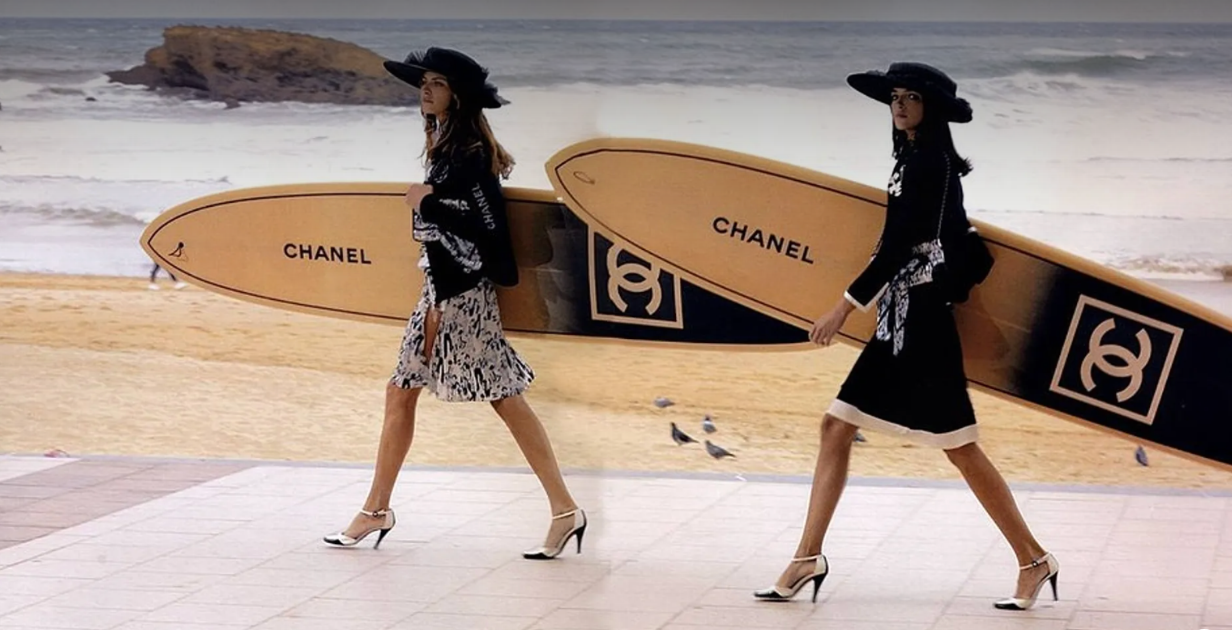
To be fair, sport and luxury have always overlapped, though usually in the opposite direction. Hermès began making saddles and harnesses in 1837 before becoming a luxury powerhouse. Pringle of Scotland was a knitwear pioneer whose clothing found its way onto golf courses, while Lacoste was founded by an actual tennis champion. These brands built their reputations on something practical before becoming fashion staples. And let’s not forget Karl Lagerfeld sending Linda Evangelista down the Chanel runway carrying a surfboard back in 1990. It was playful, a bit ridiculous and very much part of the joke. Lagerfeld wasn’t proposing that Chanel become the next big name in surfing. What’s changed is the direction of travel. Today’s luxury houses aren’t evolving out of sport or simply having a bit of fun with it on the runway. They’re putting their logos on existing sporting equipment and turning what was once an occasional novelty into an entire product category, whether or not anyone previously associated them with athletic endeavour.


And perhaps there’s another reason these products are finding an audience. Fashion has spent years encouraging wealthy people to look as though they aren’t particularly interested in appearing wealthy. Cashmere so discreet it practically apologised for existing. Unbranded baseball caps. Loro Piana loafers. Clothing that communicated status only to the people already fluent in the language. The problem with quiet luxury is that it eventually stops being particularly quiet. Once everybody knows what a Loro Piana loafer looks like, it ceases to function as a secret handshake. It’s simply another status symbol. A quieter one, certainly, but a status symbol all the same.
Meanwhile, the people becoming spectacularly wealthy don’t necessarily resemble the old-money archetypes luxury marketing loves to romanticise. A generation raised on technology platforms, personal brands and extreme visibility may not be especially interested in pretending their wealth doesn’t exist. Many of the fortunes being created today are public by nature. Visibility isn’t embarrassing. In some cases it’s part of the business model.
aspiration
Viewed through that lens, luxury sporting equipment starts to look a little less absurd. A Louis Vuitton racket case isn’t subtle. Nor is a Prada table-tennis set. Neither is an impeccably arranged collection of Dior Pilates equipment occupying an entire corner of a home gym larger than most London flats. These aren’t objects designed to disappear quietly into the background. They’re conversation pieces. They’re evidence. They’re demonstrations.
For decades, luxury fashion largely acted as a cultural headquarters. Trends emerged from fashion and filtered outward. Increasingly, the relationship appears to be working in reverse. Running clubs built their own culture. Pilates built its own status. Tennis never stopped looking aspirational. Wellness became an industry long before luxury fashion arrived carrying a yoga mat. Fashion is looking out into the world, identifying where aspiration already exists and finding increasingly inventive ways to attach itself to it.


Some of those efforts are successful. Some are genuinely beautiful examples of craftsmanship. Some are unintentionally hilarious. Most manage to be all three at once.
I can appreciate the workmanship behind a pair of Chanel skis, admire the absurd confidence required to make a leather tennis-ball holder and still question whether anyone genuinely needed either. But necessity has never really been the point.
The Hermès skateboards, the Louis Vuitton padel set, the Prada tennis accessories and the Dior Pilates collection feel like more than novelty products because they’re clues about where fashion thinks aspiration lives now. Not exclusively on the runway, and not entirely within fashion itself.
Luxury once told people what was desirable. Increasingly, it appears to be following people towards the things they’ve already decided are worth wanting.
Ultimate status symbol or peak absurdity? Join the debate and let us know what you think on Instagram @GloriousSport
Title image: Chanel Spring-Summer 2003 campaign, Chanel
Share This Article
If you love this you’ll also love...
Safe Bet
Sydney Sweeney took her clothes off, Novig put its money on everyone looking, and the bet paid off. But when one of sport’s newest businesses reaches for advertising’s oldest trick, who exactly is winning?
Beyond The Hype
From CDG x Salomon to Jacquemus x Nike, luxury fashion and sportswear collaborations are everywhere. We investigate the reasons behind this ever-booming trend.
The Long Game
Fashion and sport have always flirted, trading looks and stealing from each other’s wardrobes, but this season feels different. The flirtation is over. They’ve finally tied the knot, creating a power couple built on ambition, imagination and reach.
Between Heats
We grab a chai with surfer Gabriela Bryan to talk life on the WSL Tour, Sephora splurges, the logistical problems of scrapbooking, being besties with someone you might have to beat in the next heat and the rather enviable reality of spending your twenties chasing the best waves on the planet.