
Cold Couture
Six hundred and sixty hours of hand-beading, one lost FedEx package, a tribute to the Spice Girls and a $100,000 Oscar de la Renta dress. Figure skating just had its most fashionable Winter Games ever.
By Glorious
Figure skating has always been the sport most likely to make you forget you’re watching athletics. The jumps are extraordinary, yes, but let’s be honest, half the reason the world tunes in is to see what everyone’s wearing. At Milano Cortina 2026, that instinct has been fully, gloriously vindicated. Because this year, the ice became a runway, and fashion finally noticed.
It helps that the Games landed in Milan. One of the four fashion capitals of the world, a city where even the airport feels like it’s dressed better than you. The timing was not a coincidence, and the skaters rose to the occasion spectacularly.
Before we get to the sequins, a quick but deliciously ironic detail. The Olympics is one of the most tightly controlled commercial environments in global sport, and figure skating costumes answer to their own strict rulebook too. Visible commercial branding remains strictly forbidden on competition attire. Which means you won’t see a double Chanel C or an LV shimmering on a bodice. Couture can collaborate, campaigns can explode across social media, but the ice itself stays almost entirely logo free, leaving the garments to speak for themselves as unbranded masterpieces of pure craft.
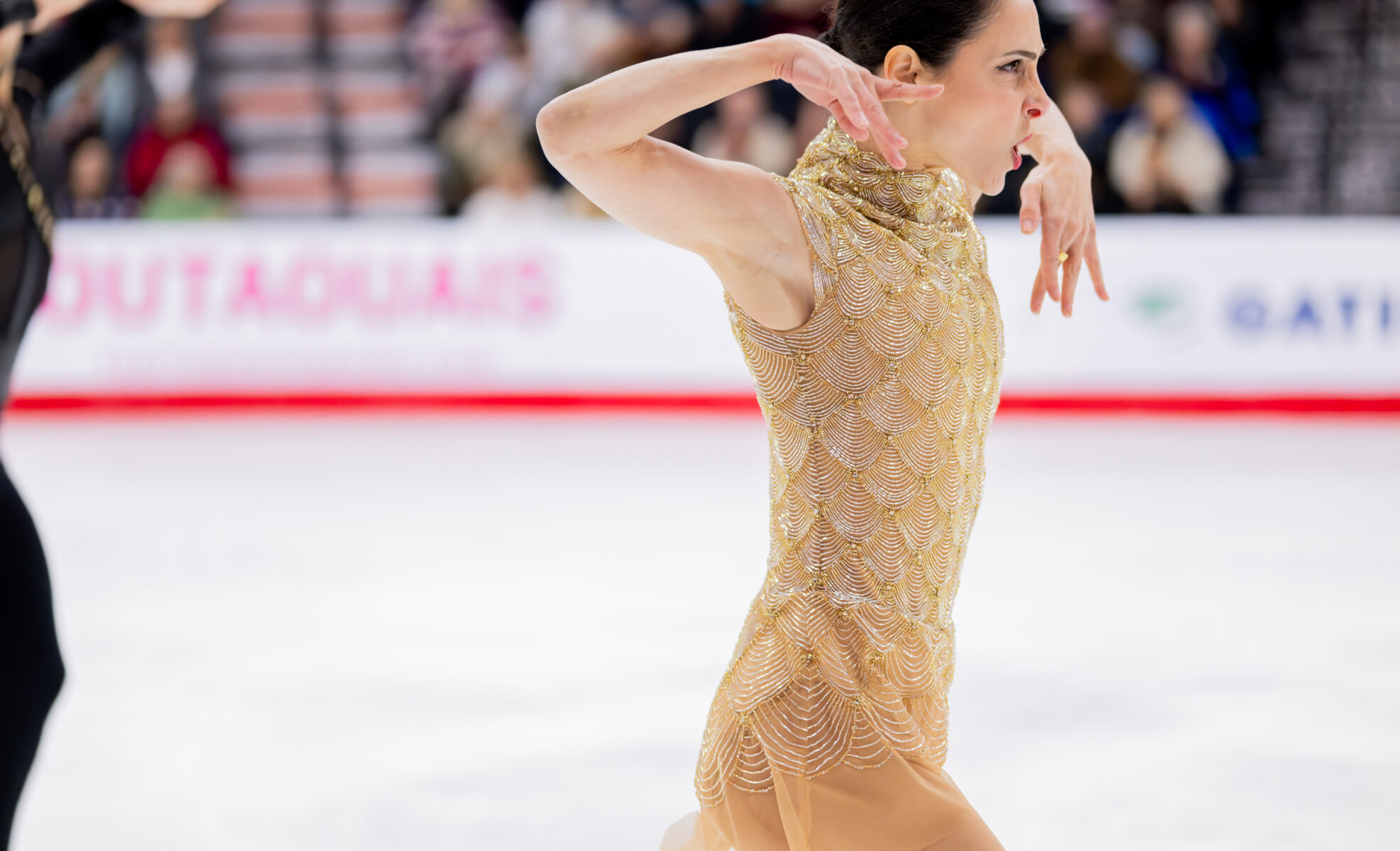
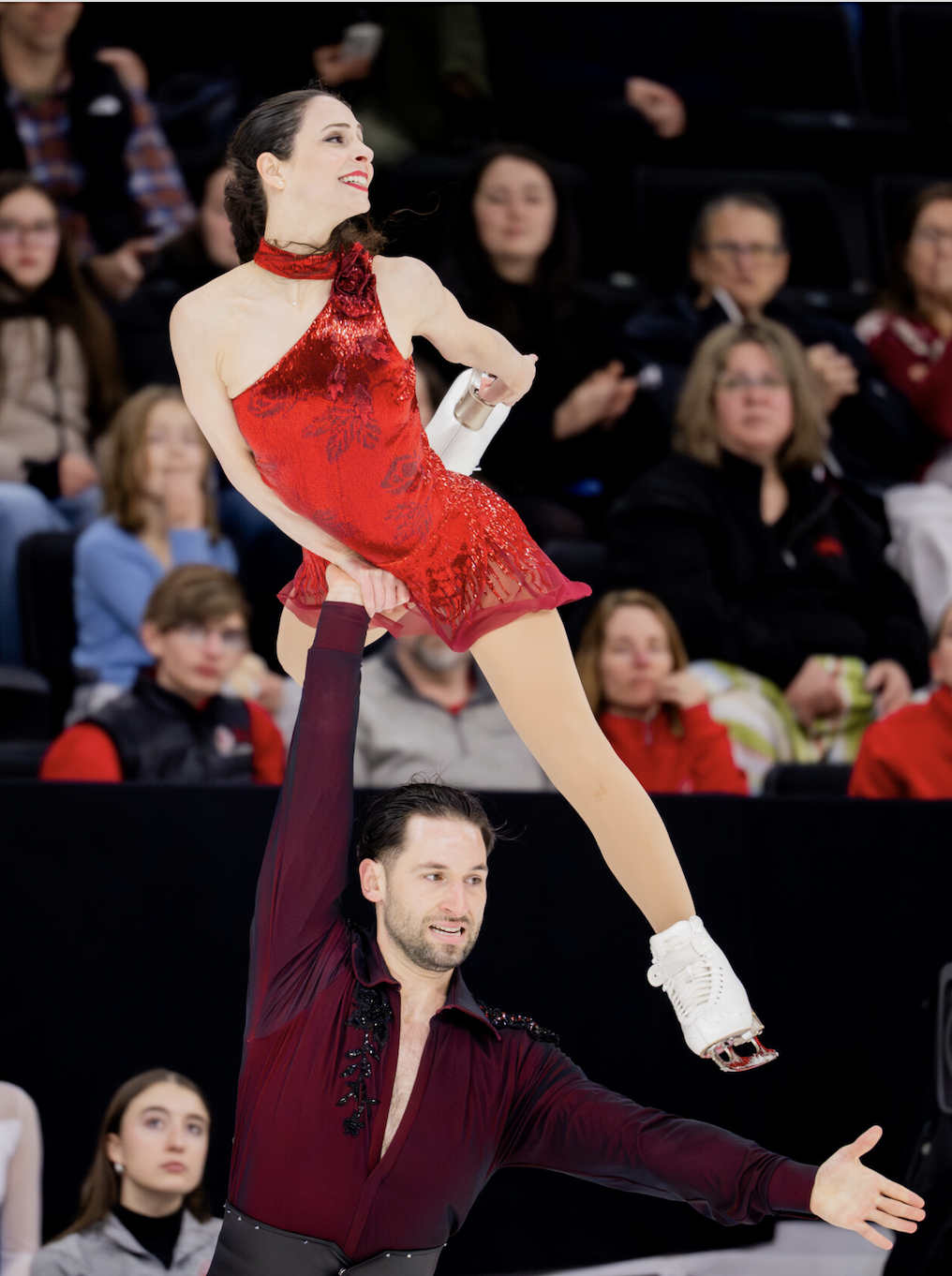
The headline collaboration of the entire Games involves a 42-year-old Canadian pairs skater, a 60-year-old fashion house, and two dresses so extraordinary they deserve their own paragraph each. Deanna Stellato-Dudek arrived at Milano Cortina wearing custom Oscar de la Renta, the brand’s first-ever figure skating costume in its six-decade history. This did not happen easily. Stellato-Dudek spent a year contacting designers with no success before a Skate Canada board member made a phone call to the right people. After a long wait, the house agreed. Nine months of work followed.
The short programme dress is gold, hand-beaded, and encrusted with over 100,000 crystals assembled over 660 hours. The long programme shifts mood entirely: a one-shoulder design in graduated shades of red, finished with a bugle-bead peony at the neckline, reportedly valued at $100,000.
What makes it genuinely moving is the woman wearing them. Stellato-Dudek retired in 2000 due to injury, spent 16 years working as an aesthetician, returned to the ice at 33, and became the oldest woman in history to win a world title at 40. She said she never imagined she would be wearing Oscar de la Renta at the Olympics. Given everything, she probably never imagined she would be at the Olympics at all. Those in the know are already suggesting this collaboration could mark the beginning of luxury labels properly embracing figure skating. Watch this space.
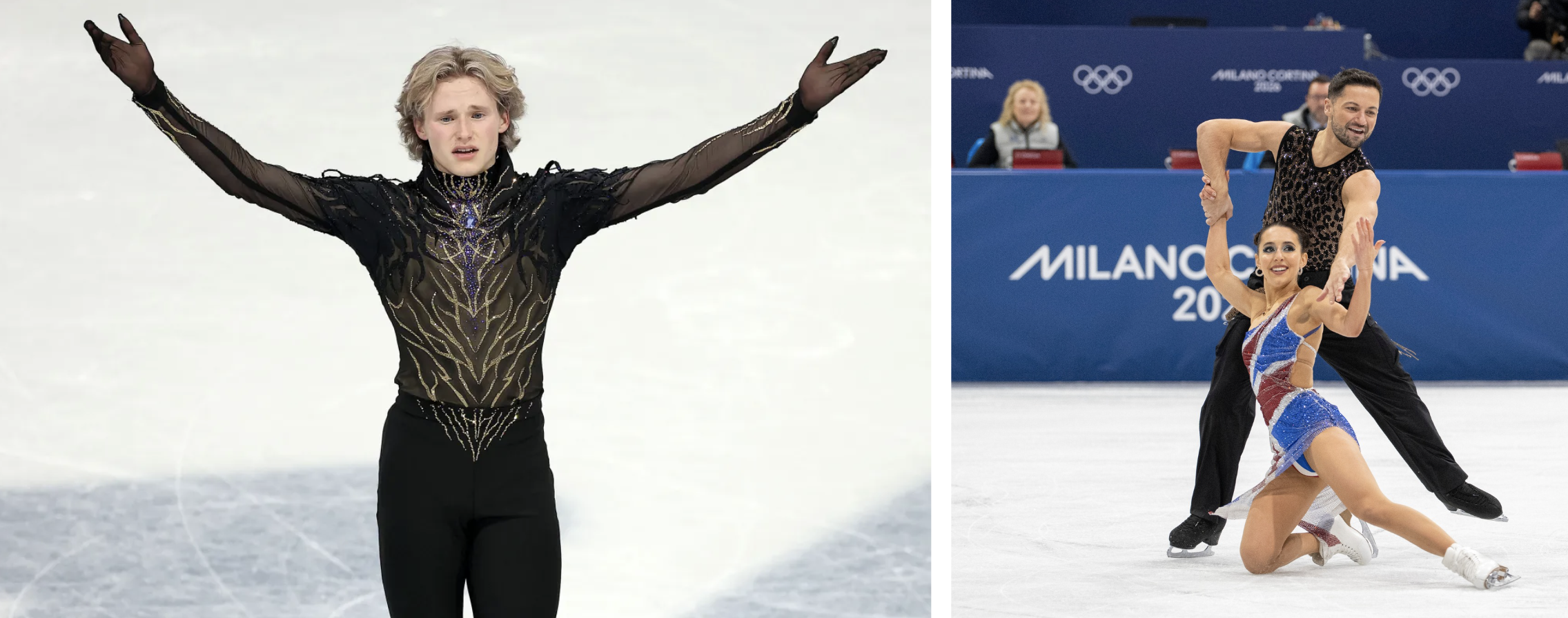
Yet, for all the glamour of the couture houses, the podium remains dominated by a different breed of creator: the Athletic Engineers. If Oscar de la Renta provides the high-fashion fantasy, designers like Ito Satomi and Lisa McKinnon provide the invisible engineering required to make that fantasy survive a quadruple jump. Satomi, Tokyo-based and trained in the UK before establishing her career in Japan, has become one of the most influential costume designers in the sport. At Milano Cortina she dressed Ilia Malinin, the two-time world champion widely known as “Quad God.” His short programme costume drew inspiration from the character Sargon in the video game Prince of Persia: The Lost Crown. His free programme look was black with gold extensions and blue jewel detailing, built for precision and durability under extreme technical content.
Lisa McKinnon, Swedish-born and LA-based, also played a defining role at these Games, designing for Team USA’s women, who have referred to themselves as the Blade Angels. She created Olympic looks for Alysa Liu, Isabeau Levito and Amber Glenn, reinforcing her reputation as one of the most trusted engineers of elite skating fashion.
The individual costume moments at Milano Cortina have been extraordinary. Team USA’s Isabeau Levito took to the ice in a striking red costume designed by Lisa McKinnon, a look many fans compared to classic Italian cinema glamour. Georgia’s Anastasiia Gubanova performed her free skate to music from Ghost, wearing a black-and-white dress featuring silhouettes of a man and woman on the back, echoing the film’s iconic imagery.

extraordinary

British ice dancers Lilah Fear and Lewis Gibson brought the 1990s to the ice with a Spice Girls programme, Fear in a Union Jack dress paying direct tribute to Geri Halliwell’s 1997 Brit Awards look. The best possible deployment of British cultural identity on an international stage.
Then there is Madison Chock, a three-time world champion ice dancer who not only competes at the highest level but designs too. Chock has created her own competition looks and collaborated with Canadian designer Mathieu Caron, one of the sport’s most sought-after costume architects. Caron’s work was visible across multiple teams in Milan, including Japan’s pairs champions, whose Gladiator free programme featured Roman-inspired designs that matched the scale of their music.
Elsewhere, Canada’s Piper Gilles and Paul Poirier performed their emotional “Vincent” free dance inspired by ‘Starry’ world of Vincent van Gogh. Kazakhstan’s Mikhail Shaidorov wore a costume inspired by the stillsuit from Denis Villeneuve’s Dune. France’s Adam Siao Him Fa paid tribute to Leonardo da Vinci in his short programme, evoking the Vitruvian Man, and to Michelangelo in his free skate

France delivered full fashion theatre too. Ice dancers Laurence Fournier Beaudry and Guillaume Cizeron performed their rhythm dance to Madonna’s “Vogue,” leaning unapologetically into ballroom attitude. Fournier Beaudry wore a pink corseted silhouette inspired by Jean Paul Gaultier’s iconic conical bra worn by Madonna. Her partner Cizeron matched the drama in sleek black, letting the corsetry take centre stage.
Japan’s pairs champions skated to music from Gladiator, their Roman-inflected designs amplifying the theatricality of the programme. Kaori Sakamoto’s free programme costume featured an open back with pearl-necklace detailing, complementing her Edith Piaf soundtrack.
American ice dancers Christina Carreira and Anthony Ponomarenko overcame a last-minute shipping crisis when their costumes were delayed en route to Milan, only for them to arrive in time for competition.
Of course none of this creativity happens without constraint. The ISU requires costumes to be modest, dignified and appropriate for athletic competition, and decoration must be secure. If an element falls onto the ice, it can result in a deduction. Men must wear full-length trousers. Women were once required to wear skirts, but trousers were formally permitted again in the early 2000s. The choice, at least, is now theirs.

The exhibition gala at the end of the Games offers far more freedom, giving skaters space to lean fully into theatricality. It is often the most visually inventive session of the entire fortnight.
Figure skating has always known it was fashion. It has simply been waiting for fashion to admit it. With Oscar de la Renta on the ice and Milan as the backdrop, the acknowledgement feels less like a trend and more like a formal introduction. The ice has always been a runway. It just took a Games in Milan for everyone else to see it.
Title Image: Deanna Stellato-Dudek & Maxime Deschamps perform their short program at the 2026 Nationals in Gatineau, Que / Skate Canada
Share This Article
If you love this you’ll also love...

Cold Kits
Before a single ski leaves a track or a bobsled hurtles down the run, Milano Cortina 2026 has already crowned its fashion winners. Here's our definitive ranking of who's winning before the competition even starts.
Beyond The Hype
From CDG x Salomon to Jacquemus x Nike, luxury fashion and sportswear collaborations are everywhere. We investigate the reasons behind this ever-booming trend.
Winter Games Guide
The most geographically ambitious Winter Games in history are under way! From Milan’s ice rinks and art institutions to the Dolomites’ snow-covered slopes, this is your complete guide to Milano Cortina 2026, whether you’re travelling to Italy or watching from home.
10 Mins With...
Kirsty Coventry runs the Olympic Winter Games on little sleep, strong tea and a pocket full of pins. As President of the International Olympic Committee, she reveals what it takes to deliver Milano Cortina 2026, one of the most complex sporting events in the world.