The Line
No course.
No safety net.
Just a Utah mountainside, a shovel and some of the best freeriders on the planet. We head to the 2026 edition of Red Bull Rampage.
By Glorious
Photography by Dominique Powers
“It’s been sick!” says Mikayla Parton, a Scottish mountain biker and Red Bull Rampage rookie who has just spent the best part of a week preparing to throw herself down a mountain in the Utah desert.
It is a fairly relaxed way to describe an event that involves navigating sheer cliffs, enormous jumps and narrow ridgelines on a bicycle, with very little room for error. But then, Parton is a former World Cup downhill racer. This is exactly the sort of riding she came for. “My main goal of the year was to go to Rampage,” she explains. “So obviously being here right now is, like, great!” she laughs as she gestures around the event.

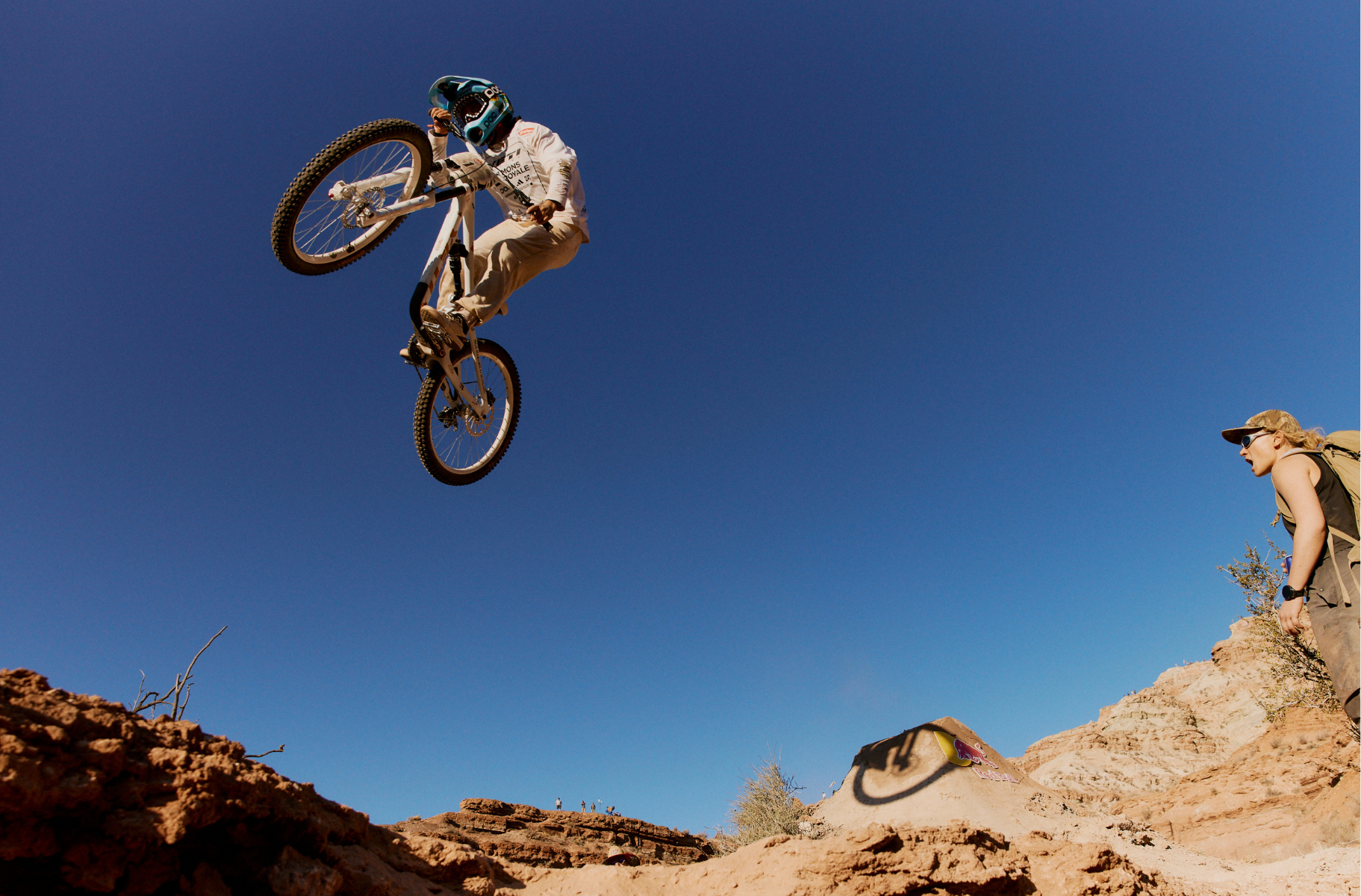
Red Bull Rampage is one of mountain biking’s most extreme competitions, although describing it as a competition doesn’t quite capture what happens. The event has long been held in the desert around Virgin, Utah, but the exact site changes periodically, giving riders new terrain to tackle. This year, it brings together the world’s best freeride mountain bikers on an enormous, largely untouched mountainside. There is no designated course and no race against the clock. Instead, riders must create their own route down the mountain, incorporating drops, jumps and technical sections, before performing a descent judged on difficulty, creativity, style and control. It is part extreme sport, part construction project and, from the outside, barely believable.

CREATIVITY

The event began in 2001, but women only joined the official competition in 2024. Before that, Red Bull Formation, established in 2019, had provided a platform for female freeriders to develop their skills and push the boundaries of what was possible on the same unforgiving Utah terrain. By the time the inaugural women’s Rampage arrived, the athletes were already riding lines that would once have seemed unthinkable. What they hadn’t had was the chance to compete at Rampage itself.
This year, to celebrate Rampage’s 25th anniversary, organisers returned to the original competition site, used between 2001 and 2004. For the first time, the women would compete on the same venue as the men, sharing a start gate and sections of the mountain. At more than 200 metres of vertical descent, it was also the tallest venue in the event’s history. The women had three years of Rampage behind them, but were now riding a piece of its earliest history.

Canadian rider Georgia Astle was excited about the location. “I thought it was super cool, especially to tie in with the 25th anniversary,” she says. “It’s really special for it to be back here and feel that connection to the OG freeride roots.”


That connection came with some distinctly old-fashioned working conditions. Before anyone can ride a Rampage mountain, they have to build their way down it. Each athlete selects a route, known as a line, and works with a small crew of diggers to transform sections of the natural terrain into something rideable.
Jumps need takeoffs and landings, steep sections need shaping, and the loose desert soil must be compacted well enough to withstand the impact of a mountain bike travelling at speed. The work is done largely by hand, with shovels, picks and buckets, and the riders spend days climbing up and down the mountain before the competition even begins.

This year, the absence of water hoses made everything considerably harder. Water is normally used to help bind and compact the dirt, so without it, constructing a landing became an exercise in patience. “It’s taking so much longer to build landings and make sure everything isn’t crumbling because we just don’t have a hose to use,” explains Astle. The sheer size of the venue added another complication. “There’s actually so much in between that you need to build still and make sure that you’re dialled.”

Where most people see a cliff face, the riders see a possible jump, calculating the speed, angle and braking required to navigate terrain that appears inaccessible. British rider Natasha ‘Tash’ Bradley, who is based in New Zealand, sees the mountain differently from most people, including photographer Dominique Powers. Looking at the same enormous cliffs, Powers sees a sheer drop. Bradley is already working out what she might be able to jump off. “Yeah, I could jump my bike over that,” she says, as though discussing a manageable kerb.

Bradley had already made history earlier in 2026 by becoming the first woman to clear the 110-foot Falcon Heavy jump at Darkfest, another event devoted to the more outrageous possibilities of mountain biking. Yet even she wasn’t entirely convinced Rampage was for her. “To be honest with you, I didn’t know what to expect,” she laughs. “But I figured, well, might as well just give it a go.”
consequence

The risks became painfully apparent when Bradley suffered a serious crash attempting a 60-foot canyon gap during practice, undershooting the landing and sustaining a broken femur and shoulder. It showed the physical consequences involved, even for the most experienced riders. Every jump, drop and landing must be considered carefully, particularly when much of the terrain has been constructed only days earlier.
Rampage is also an unusually collaborative sport. Riders rely on their digging crews, share knowledge and sometimes even share sections of their lines. American rider Janelle Soukup, who made her debut in 2025 at just 20 years old, spoke about the challenge of placing that much faith in other people. “Even if you’re super competitive, you genuinely have to put your trust in other people,” she says. “You have to take it step by step, which is really hard sometimes.”

There is also the weather to consider, which can undo days of careful preparation. Wind, heat and changes in the condition of the dirt can affect everything from the stability of a landing to whether a particular jump is safe to attempt. “It’s not what’s happening, but it’s how you react to it,” says Soukup. “You never know what’s going to happen with the weather. It’s all about how you adjust and adapt.”

New Zealand’s Vinny Armstrong was similarly struck by the complexity of the terrain, especially the way different riders’ routes intersected across the mountain. “It’s like a whole other layer on top, the crazy features going on and crossovers,” she explains. Armstrong would eventually finish fourth, earning recognition for her distinctive riding style, while Astle’s crew received the Digger Award for their work on the mountain. Few sports reward the people who build the course as visibly as Rampage does.


By competition day, the mountain was divided into lines that reflected each rider’s strengths, with some built for enormous jumps and aerial tricks, others for precision and technical riding. The athletes had two opportunities to complete their lines, with their highest-scoring run determining their position.

And once again, Robin Goomes was the woman to beat. The New Zealander had won the inaugural women’s Rampage in 2024 and successfully defended her title in 2025. A third victory would make her the first rider in the event’s history, male or female, to win three consecutive titles. But the competition was getting stronger, and repeating what she’d done previously was unlikely to be enough. “The pressure seems to just keep building,” Goomes admitted. “All I knew this year is that if I wanted to do it again, I’d have to push harder than I’ve ever done and be better than I have been previously.”

Back home in New Zealand, she had built a training compound to practise a backflip step-down, repeating the movement until it became second nature. At Rampage, she produced another historic moment, landing the first flat spin 360 by a woman in the competition’s history. The trick earned her the Best Trick Award and contributed to a winning score of 93.50.
It was far from a comfortable victory. American Hannah Bergemann finished just 0.75 points behind on 92.75, having recovered from a heavy practice crash on a steep drop known as the Big Lebowski. She returned to successfully ride the feature during her finals run, securing second place for the second consecutive year. Canada’s Kirsten Van Horne completed the podium with 86.50, followed by Armstrong in fourth and Australia’s Harriet ‘Haz’ Burbidge-Smith in fifth. Parton finished seventh, Astle eighth and Soukup tenth.


HISTORY-MAKING
For Bergemann, the result was almost secondary to the work required to get there. “The podiums are just the cherry on top of the week,” she explained afterwards. “So much goes into this event behind the scenes. Months and months, years of prep on the bike, getting everything ready, then building for ten days and practising… by the time you get to comp day, you just want to do your thing.”
Goomes, meanwhile, was still absorbing the significance of her third title. “Winning once was something I never thought I could accomplish, so winning this third title is a dream,” she said.

The 25 years Rampage is celebrating sit alongside a much shorter history for its women’s competition. The original event helped establish freeride mountain biking as a spectacle, with riders pushing the limits of what could be achieved on increasingly ambitious terrain. The women have arrived into that history, but they are also changing what a Rampage line can look like, bringing different backgrounds, riding styles and ideas to the mountain.
Three editions in, they have already produced the competition’s first three-time consecutive champion, seen Goomes land the first women’s flat spin 360 and developed a field in which the competition gets stronger every year. There is no definitive way down, no perfect route and no guarantee that something carefully planned will work once the wheels leave the ground. Every year, the riders return to the desert and see something different, and for the women, there is still plenty of mountain left…

Photography by Dominique Powers, follow her here.
For more information about Red Bull Rampage, click here.
Share This Article
If you love this you’ll also love...
Dig & Drop
To defy gravity takes more than nerve. The women of Red Bull Rampage don't just ride, they use fearless skill and revolutionary collaboration to conquer Utah's cliffs and reshape extreme sport forever.
Cape Epic
Kate Courtney has spent much of the past year doing things she didn’t expect. The two‑time world champion talks risk, rediscovering the fun in racing and returning to the brutal Cape Epic for her new Red Bull film Everything to Gain. What happened next surprised even her.
Mary, Quite Contrary
Kim Kardashian may have recently swerved Martin Brundle on the Monaco grid, but Mary McGee stopped him in his tracks. As Le Mans returns this weekend, we revisit the life of a motorsport original who raced cars, conquered Baja and made history on two wheels.
Building Tracks
What kind of person must you be to throw yourself off sheer 40-foot drops in the desert? For the first time in its 23-year history, audacious female athletes stand shoulder to shoulder with their male counterparts, making their mark on freeride’s biggest stage: Red Bull Rampage.