The Other Marathon
Running a marathon is one thing. Watching someone you love do it, armed with fourteen WhatsApp groups, a shouting voice and a loose grip on logistics, is another. Together, they make the one day a year London remembers how to be kind out loud.
By Glorious Bec
I am a Londoner. I am, more reluctantly, a marathoner. I have run London once, I have said never again, and I have meant it in the way you mean things while sitting on the floor of a Pret near Blackfriars in a tracksuit, crying, which is to say completely and non-negotiably.
My girlfriend is running this year’s London Marathon. I am not. Which means I have spent the last six months in training as a spectator. I have watched the 6am alarms, the gels accumulating on the kitchen counter, the Sunday runs that eat half a weekend. I have even tried to take part in the training myself, with results I’ll come back to.
Ballot emails came in October. I had put my name in back in the summer, in the kind of early-relationship haze where you will agree to almost anything, and had imagined us opening them side by side on the sofa, screaming either way. By October we were, as they say, less new. Mine arrived first. NOT SUCCESSFUL. I tilted my head slightly, as if surprised. Hers came fifteen minutes later. IN THE BALLOT. She screamed. I did the small involuntary face of a person who has just been told they no longer have to attend a party they did not want to go to, which she clocked immediately and forgave on the spot, because she is, as a rule, sensible.
And so this year it’s her running. It’s me on the kerb. In fairness to both of us, this is the order of operations that suits our temperaments best.

The crowd has a strange kind of power. I have known this, in various forms, for as long as I have been running. What I had not properly felt, until earlier this year on a rainy morning in Bath, was what a crowd does for a person who is about to quit.
She had entered the Bath Half as part of her London build-up. I had entered it for reasons best described as misplaced solidarity, on the basis that an unserious half marathon was a manageable thing to do, and not, as it turned out, a completely different sport when you haven’t done the training. By mile 9 my ankle hated me. I had, I suspected at the time, lost a nipple. I was in the specific mental room where you rehearse the speech you will deliver in the car about why you pulled out. She had been sent ahead. She was on a mission. I was not.

And then, on the corner of some Georgian terrace, drenched, shouting my name with the force of four people trying to be heard through a PA system they did not have, were my brother, his wife, my two small nephews and a double buggy.
I had not invited them. They had got up at 5am. They had fought both children onto a train. They had, between them, produced a piece of A3 on which the two-year-old had drawn a red smudge that I took to be either a heart or the running equivalent of a warning label. They were smiling and jumping up and down. I started crying almost at once, in the way one does when one is already mildly dehydrated and emotionally undefended.
Certain clarities arrive fast. If my brother had hauled a double buggy across three trains to stand on a corner in the rain, I could not, in good conscience, drop out at mile 10 of a half marathon I had paid actual money to enter. I half-jumped the fence to hug all of them. I told the budding-artist nephew that he was my favourite and I got back on the course.
The next mile, I felt every single person on the side of the road. A pensioner with a plastic clapper, furiously waving it in the air. A woman on her mobile scooter shouting my name with the warmth of someone I had known for years. A pack of students outside a pub bellowing encouragement at anything moving. I finished. I was fine. Without them, I would have been in a taxi at mile 10. That was the moment I understood, properly and for the first time, what a crowd does for a person who is doing something difficult.
Like everybody else I know, my mornings consist of the Victoria Line and a slow, committed scroll through news which is, frankly, bleak. Wars. Stabbings. Cost of living. Whatever the current low hum of dread happens to be that day. I am not naive about this. I know perfectly well that if I asked the man scowling at his phone for directions, nine times out of ten he would look up, give me a small apologetic smile, and Google Maps it on my behalf. People are mostly kind. People are, in small private ways, continuously good to each other. This is a thing we all know.

It just isn’t, generally, how the city advertises itself to you at 8.17 on a Monday morning.
Which is why, occasionally, it helps to have a proper reminder. A loud one. One you cannot miss. Case in point: the marathon.
A significantly bigger race, to put it mildly, than the one I nearly bailed on in Bath.
On Sunday, 59,000 people will run across London. Many of them for somebody who isn’t there. Sometimes literally, on a vest. Sometimes in the handwriting of their own mother on a piece of cardboard. Sometimes in their head, where the rest of us don’t get to see it. Some are running for a charity. Some for a time they’ve been chasing for a decade. Some because they signed up last year and have failed to find a good way out since. And a million more people, give or take, will stand along the road and shout for all of them.

MISSION
London doesn’t normally behave this way. Eye contact in this city is treated, on most days of the year, as an act of mild aggression. On marathon Sunday, the city briefly forgets to be itself. A Deliveroo rider will stop his bike to clap a stranger hobbling past. Pub tables spill onto the pavement before noon. People lean out of upstairs windows and shout well done to someone they will never see again.
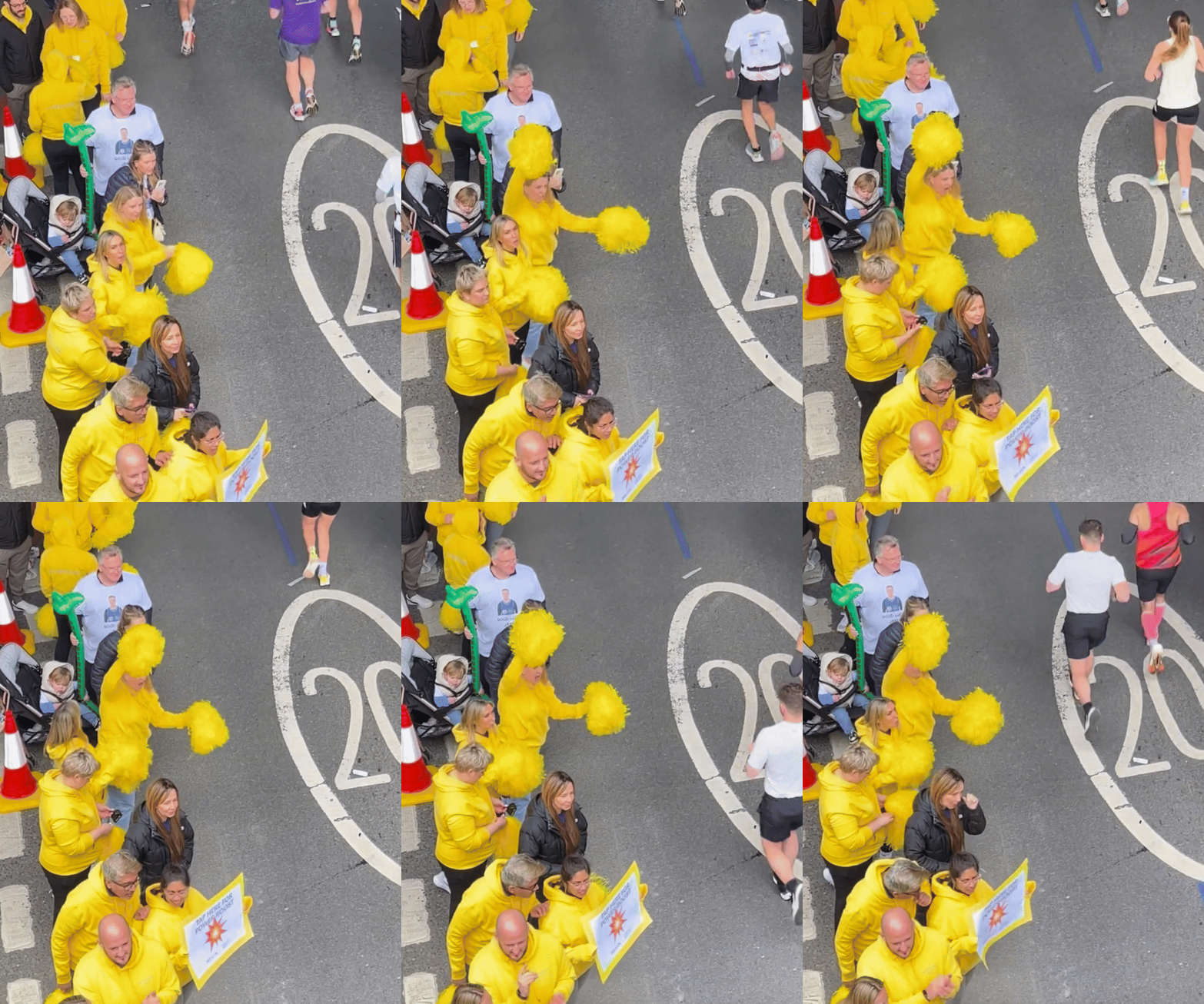
The roads close from four in the morning. Thousands of volunteers have been on their feet since before breakfast, handing out water, gels, orange segments, and the kind of patient warmth people don’t tend to give strangers for free.
The City of London wedges ice cream vans across side streets as road barriers, which is unserious municipal engineering of the highest order. Dowgate Fire Station on Upper Thames Street, the only fire station inside the Square Mile, turns its hoses out as a cooling mist for overheated runners. Their fire dogs, slippers on, watch the whole thing go past with appropriate gravity.
Run clubs and crews have their own stretches of the course, fixed spots with speakers and banners, their own people to wait for and a hundred more to adopt on sight. If you’ve ever turned a corner ten minutes from Tower Bridge and been hit by the sound before you could see what it was, you know exactly what I mean. It’s the noise of a whole city shouting for people it has never met.
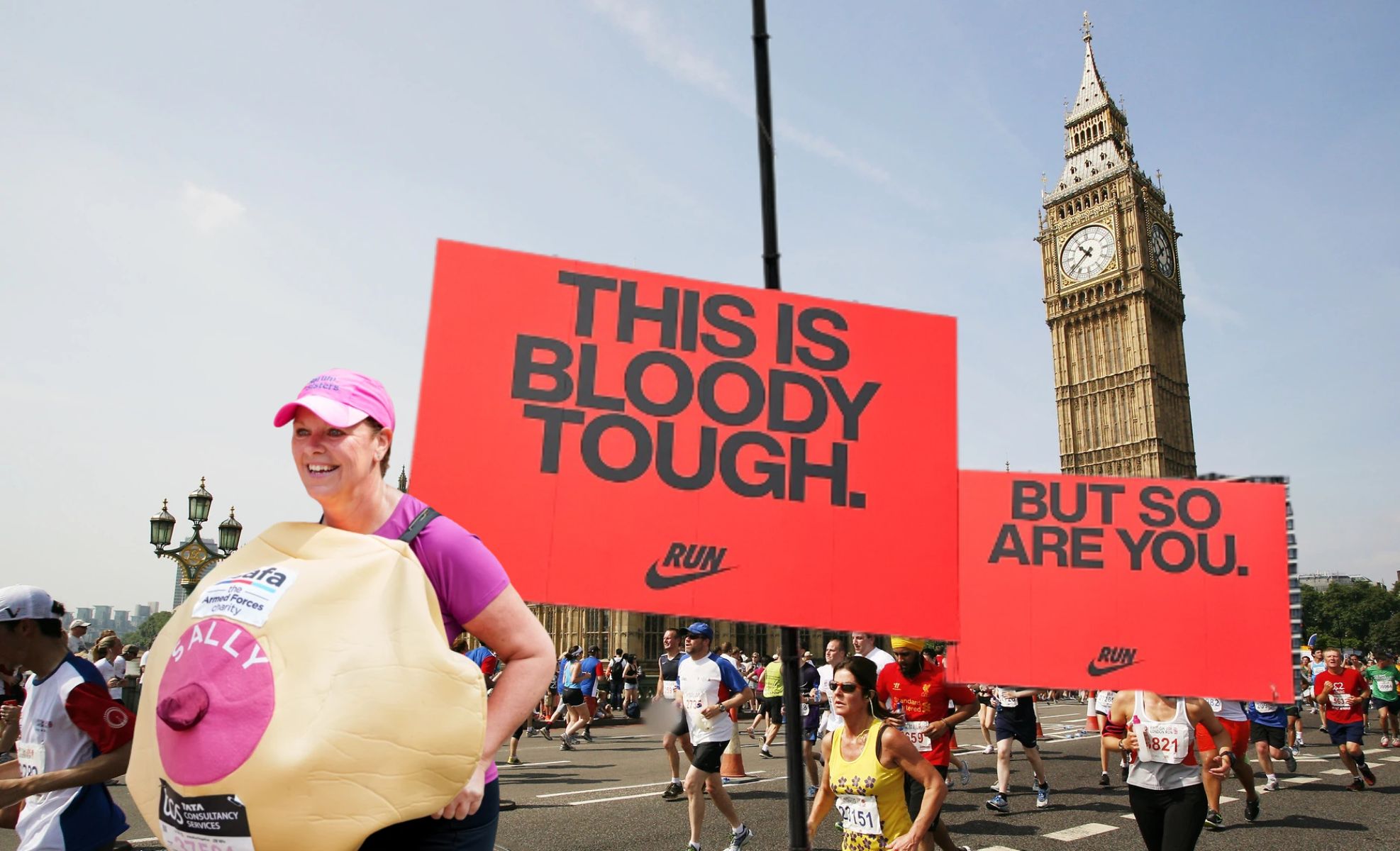
You can shout for nobody in particular. You can shout for everybody. You’ll find yourself willing on Mike at mile 10, who is already going slowly, already cramping, already doing the little sideways hop. Mike doesn’t know you. You don’t know Mike. But for the four seconds Mike is in front of you, you are his whole cheer squad. Ten miles later you’ll do the same for Sally at mile 20, still looking unreasonably fresh, the kind of runner who makes you wonder whether you understand the sport. You’ll scream encouragement at her like you went to school together.

Last year, between them, that crowd helped the runners raise £87.3 million for charity. A world record for a single-day fundraising event. The cumulative total since the first London Marathon in 1981 is over £1.4 billion. Those numbers are doing something. Somewhere, a hospice has a new wing. Somewhere, a research team has another year of funding. Somewhere, a family is being looked after by a charity they only found because someone decided to run 26.2 miles.
So on Sunday, you’ll find me somewhere around the O2, then somewhere around Tower Bridge, then The Mall. Getting between all three will require: a sign, the official TCS London Marathon tracking app, a WhatsApp group containing the fourteen people I’ve stationed along the route like some kind of under-resourced military operation, two secondary WhatsApp groups running in parallel for my work colleagues and my brother’s friend with the good camera, Citymapper, a Lime bike account on standby (read our navigating London marathon guide here), and the particular peace of a woman whose legs are, at that precise moment, not the problem.
My girlfriend will be doing the running. I’ll be doing the shouting. For her. For Mike. For Sally. For the man in the chicken costume. For the woman with the photograph of her brother pinned to her back.
If you’ve been wondering whether to come down, come. Stand somewhere between mile 16 and mile 23. Bring a flask. Shout for whoever goes past. You’ll lose your voice entirely. On Monday morning you’ll shuffle into the office hoarse, aching, slightly tearful, and functionally indistinguishable from the colleague who actually ran 26.2 miles on Sunday and is, by her own account, missing a nipple. In the end, you both took part. You just did different bits of it.
The world, most days of the year, is loud with bad news. Once a year, on a thirty-mile strip of London, it’s loud with something else.
Whether you’re running, clapping from the sidelines or just here for the free pizza and beer- read our Glorious Guide to the TCS London Marathon HERE.
Let us know your marathon story over on IG here: @glorioussport
Share This Article
If you love this you’ll also love...
Marathon Guide
You don’t need a race number to take part in the London Marathon. Just a loud voice, a carefully plotted route across the city, and a willingness to chase crowds, cheer strangers and claim your post-race carbs.
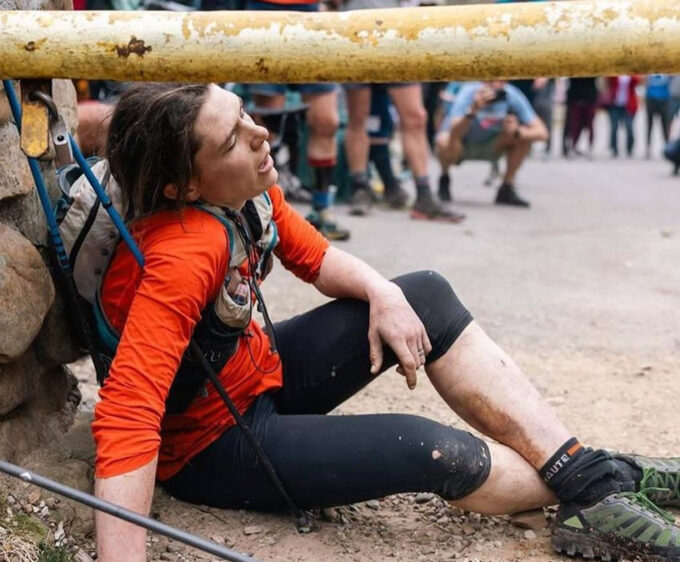
Jasmin Paris
Jasmin Paris has entered the history books as the first woman to conquer the Barkley Marathon. Join us as we unravel the mysteries surrounding this secretive and legendary ultramarathon.
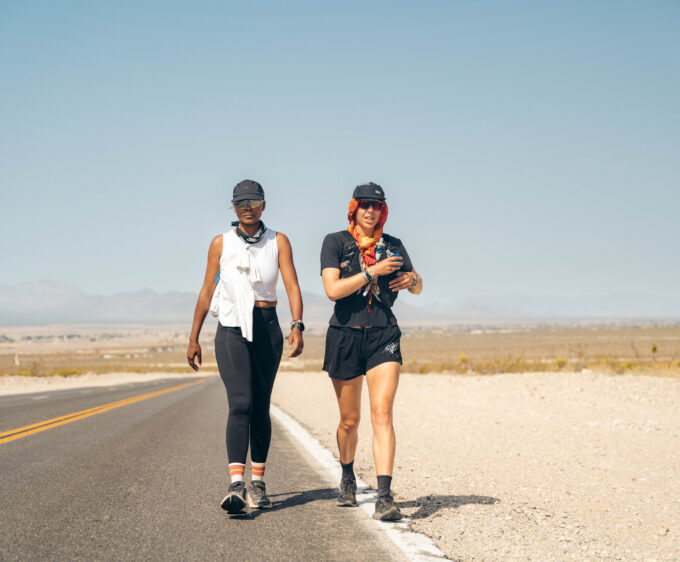
RADICAL WHO?
The Speed Project is a coveted, near-mythical 340-mile desert race built on the promise of total freedom: no route and no rules. Runner, filmmaker and activist Tilly GW has spent five years helping to make that promise a reality.

Cult or Community?
Record numbers of Gen-Z and Millennials are now taking to the streets in the form of run clubs, but are we celebrating inclusivity, or have we inadvertently formed a new kind of cult? One writer finds out…